Tableau building (with a twist)… check! Gameboard map building… check! Bingo game mechanics… what?!
Ecos: First Continent — A Top 10 Review
NOTE: I am going to be reviewing all of the games in my Top 10 Games of All Time. This review is the first in that series where I will talk about my #10 game of all time — Ecos: First Continent.
Tableau building (with a twist)… check! Gameboard map building… check! Bingo game mechanics… what?!
When someone described Ecos: First Continent as a tableau builder with Bingo mechanics, I said to myself “How can that be any kind of fun? Bingo is the pinnacle of random!” However, I was intrigued. So I investigated and discovered a fantastic gem of a game that not a lot of people have discovered yet.
Gameplay
There are two types of cards in the game. The blue cards typically generate victory points. The brown cards typically make adjustments to the game board (e.g., adding tiles, moving animals, adding features, etc.). Each card can be activated 1 to 4 times (after activating its final time, the card is removed from your tableau).
Along the left edge of each card are a series of elements. These are the elements that will be drawn out of the bag. As elements are drawn from the bag, you will cover up the elements on the cards in your tableau. When a card has all of its elements covered, that card will activate.
Each player starts the game with 7 cubes. Over the course of the game, you may add to your pool of cubes. These cubes will be used to cover the elements on your cards. As cards activate, you will return cubes from the activated card back to your pool. If you run out of cubes, you can move cubes from card to card (though this is very inefficient; you don’t want to run out of cubes very often).
Each player begins with a small player board. Each time you do not place a cube on a card (because you can’t or because you choose not to), you will rotate your player board 90 degrees clockwise. After two rotations, you may choose to draw a new card to your hand. If you draw a new card, you rotate your player board back to its starting position. If you didn’t choose a new card, you can (on a later turn) rotate one more time. You must then either gain another cube to your pool or play a card from your hand into your tableau (and then rotate the player board back to its starting position).
Every player will have a hand of 12 cards to start with. Of those 12 cards, 3 will begin in play (already face-up in your tableau). Over the course of the game, you will probably play most of the cards in your opening hand. You might even draw more cards into your hand (though you might not).
Some cards, when activated will generate victory points. Once one person has gained 80 victory points, that triggers the end of the round (60 points for the short game). Note that the game can continue for several turns after the end game has been triggered!
At the start of each round, one player will be the harbinger. The harbinger will draw a tile from the bag and announce the element to all the players (playing it face up on the table for everyone to see). NOTE: it is helpful if, before the game begins, you pull out one of each tile and designate what the element design on each tile will be called (as the symbols do not have an “official” designation). After calling out the element, each player marks exactly one of that element on one of the cards their tableau. If they choose not to (or have none of that element, they will rotate their player board). If any player has covered all the elements on a card, they will call out Ecos (not Bingo). Multiple players may Ecos at the same time. Starting with the Harbinger, all players will resolve any activating card. Note that sometimes, one card can generate elements that will cause another card to activate. It is possible that several cards in one tableau could activate in one turn.
Once all players have resolved all activated cards, the harbinger draws another tile from the bag and the process continues until the harbinger draws one (of the two) wild tiles from the bag. After drawing the wild tile and resolving all activating cards, all of the drawn tiles are replaced into the bag and the player to the harbinger’s left becomes the new harbinger and a new round begins.
Thoughts
For your first game, I would suggest that you definitely play the short game (to only 60 points). As a matter of fact, you might even want to only play to 40 points and then reset the game and try it again. Because you will make mistakes in how you play. The basic mechanics of the game are straightforward enough that you can get a pretty good feel for how to flow through the turns. It is the strategies of which cards to focus on activating that you will stumble over on your first few plays. So setting up a “practice” game (maybe even playing to only 30 or 40 points) to get a feel for how to best play your cards might be something to consider.
One of the things that makes this game unique among tableau building games is that the cards in your tableau don’t stay there. They are there for a while, then leave. This ever-changing tableau makes for some fun things to keep track of and figure out how to make cards work together most effectively (and how to time when to activate each card).
The decision space is quite a joy to explore!
There is a surprising amount of strategy in this game! On the surface, you would think that a “bingo-style” game could be nothing but a random mess. However, there are definite levels of strategy in which cards to activate; when to play more cards; when to add cubes to your pools (and when to NOT add more cubes to your pool); when do you need to draw more cards (which might be never); how do you develop the board (which tiles to add; which animals to add; how to move the animals; etc.).
Appearance
The theme for this game is fairly thin. You are supposed to be creating a continent and populating it with wildlife. I suppose that means you are some kind of god-like entity. But that theme doesn’t come through very well (you play some cards, put tokens down, etc.).
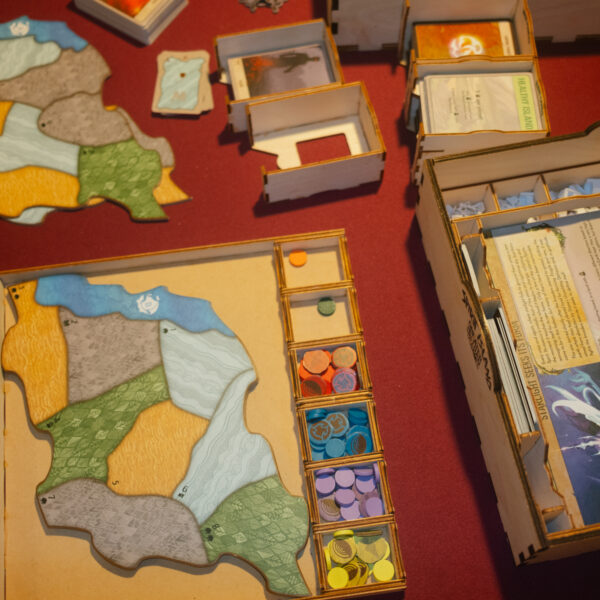
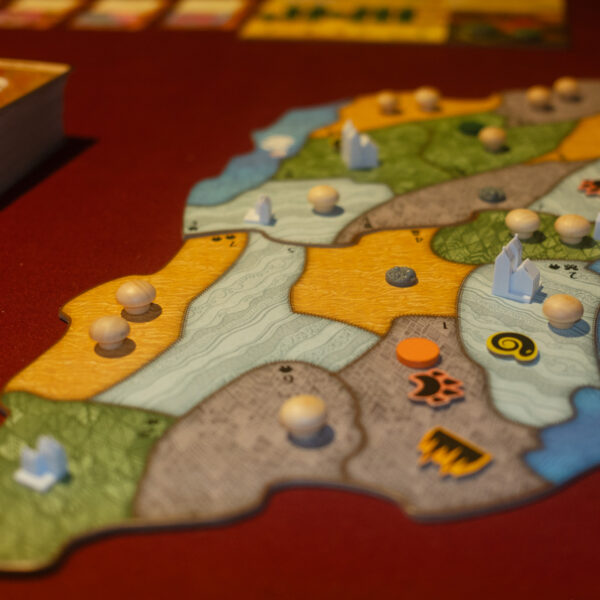
Overall, the components for this game are well above average quality. There are wooden bits (the trees and the mountains are fantastic). The tiles are also wood and have a good “heft” factor (they feel good when you draw them from the bag). The bag is an excellent size for drawing out of (even large-handed players can easily get their hand inside to mix the tiles and pick them). The land and sea tiles are good quality. There is even a minor detail and I just love… the sea tiles are just a tad bit thinning than the land tiles. This means that when the board is being built, the land tiles sit just higher than the water tiles. It has absolutely no bearing on the play of the game, but it looks great and feels great!
The animal tiles are functionally fine but are not above average. The game comes with token trays for the animal tiles, but they are made of cardboard. If you are not especially careful when assembling them, you can damage them. It would have been nice if the trays had been molded plastic.
The rulebook is not bad. As with most rulebooks, there are some organizational issues (but not enough to call the rulebook “bad”). The only other component issue that I have is that there should have been a reference card included that shows each animal and their habitats. This is referenced often on the cards, and it is a pain to have to look at each token stack to see which animals are native to which habitat.
The artwork for this game is minimal(outside of the rukebook). The graphic design is above average. All of tge iconography works well. It would have been nice if the elements were “named”… but that does not get in the way of the game
Accessibility
This game is straightforward to teach. The basic concepts are easy to understand. The only thing that might trip up some players will be some specific terminology used on the cards. There is a section in the rulebook that specifically defines these terms, but there is no reference card for a quick reminder. Specifically, the terms Community (a collection of same animal types), Landmass (a collection of same land type), and Habitat (a collection of same land types OR land features). These definitions can a surprisingly tricky for some players to wrap their brains around.
The only other aspect of teaching that will be an issue for new players to this game is to remember to do some routine tasks. Specifically, remembering to rotate power cards after each activation and remembering to rotate your player board every time you gain an element that can’t use (or don’t want to use). See below for more details on these routine tasks.
Considerations
This game plays very well and 2, 3, and 4 players. You can play up to 6 players, but after 4 players, the downtime time as you resolve cards can become a bit much. I recommend this game best at 2 or 3; still fine at 4. But play at 5 and 6 only if you don’t mind the downtime.
Because the game has simultaneous turns (mostly), the playing time doesn’t feel too long.
However, waiting for players to activate their cards can drag on at higher player counts. If you play the short game, you won’t have a lot of time to get some of the fun synergies out of your cards.
Setting the game up is straight forward. There are several variations for the starting tiles (and they do make a difference to the way the game plays out). There are two different ways to determine your starting cards. You can choose to have hands “preset” or you can draft your opening hand. Until you have played the game multiple times, you shouldn’t bother with the draft (as you won’t have a good handle on the card dynamics and synergies to make informed decisions about which cards will go well with which other cards). The preset hands work quite nicely! You do have to take a bit of time during the setup to separate out the preset hands, but it doesn’t take too long to do that. One of the interesting design decisions in the game is that there are two sets of preset hands… using two different sets of symbols. So that if you are using the preset hands, you can change it up by switching to the other set of symbols.
If you are drafting your opening hand, you will get to choose three cards to start in play. If you are using the preset hands, three cards in the set are designated as the opening cards you will have. This is a particularly nice touch as you don’t have to analyze which cards would be the best out of your set to start with in play.