This is the second post in a series of posts about my relationship to Spirit Island and how gaming has improved my mental health. You can catch up on all the posts here!
One of the biggest lies we’ve all been sold is that growing up means growing deathly serious. I always joke that we grow up and make money that’s best spent on all the toys we didn’t get as kids. Board games have unlocked an entire ecosystem of joy for me, all predicated on the idea that the more responsibility and the more weight I carry, the more I have to play. The scales are set with KPIs, stakeholder meetings, and a stream of news on one side, and a mountain of logged games of Spirit Island on the other.
Achieving balance is essential, but before I was even able to load the scales in my favor, I had to learn how to play as an adult. There were three layers to this that I had to peel back before really being able to love games to the high point of now having a room in my house dedicated to my ever-growing library of them. That is, before I could start playing, I had to understand the machinations of “play,” and after that big, esoteric task, I had to actually read the rules and learn how to physically interact with every game world into which I stepped. Finally, after all that work to figure out what it meant to play and digesting the sprawl of various rulebooks, I had to become comfortable being inherently bad at something I do for fun.
Embracing play as an adult is all about shedding pretense. My phone is full of photos me and my wife playing Spirit Island. In all of these images, I’m just doting over a pile of cardboard in a wonderland of chits, cards, and made up rules designed to scratch particular itches in my brain. Facial expressions range from various stages of grief-stricken to deeply smug as I maneuver around my precious island and play with the little toys I’ve bought with my hard-fought money. It’s silly; it’s emotionally gratifying; it’s endlessly awesome. Where growing older sands off the sense of wonder that comes with childhood and seeing the world anew, reintroducing play shapes and reforms that dust into solid pieces meant to fit into my life as a grownup.
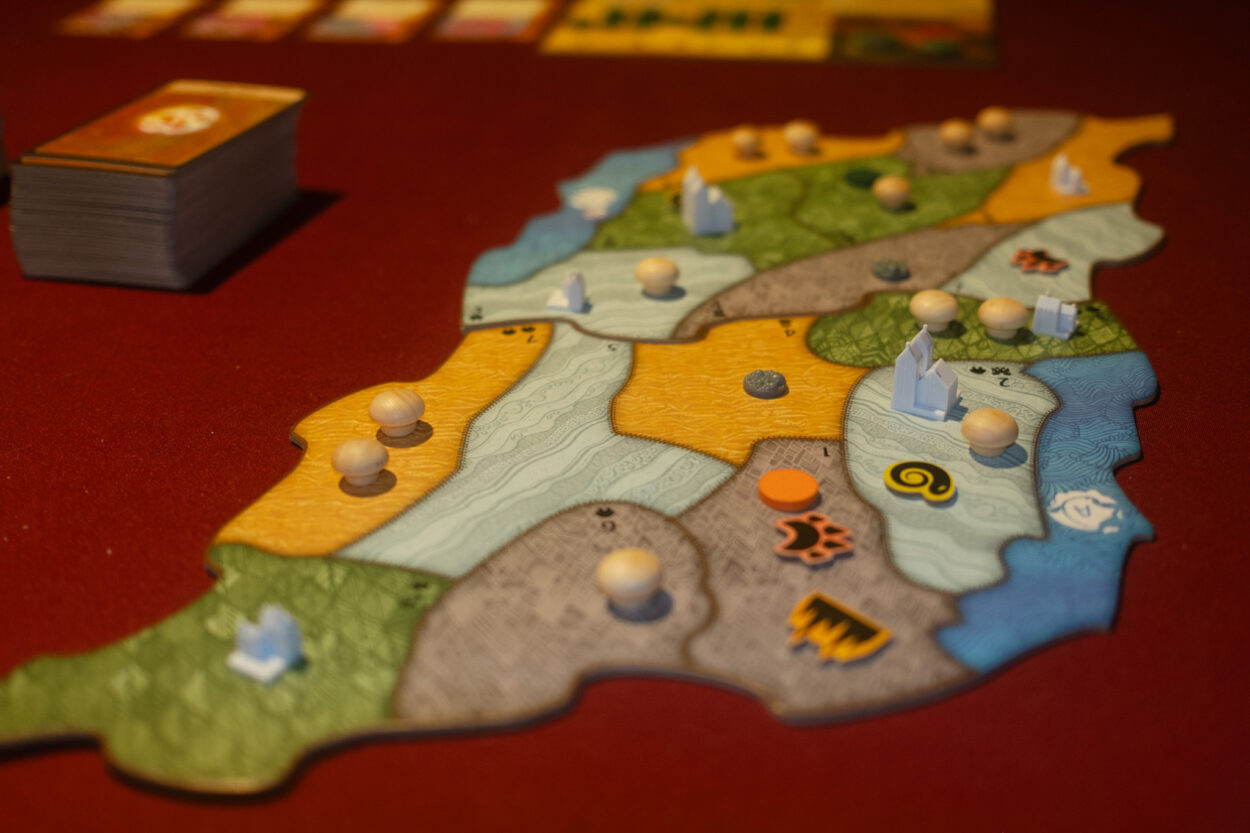
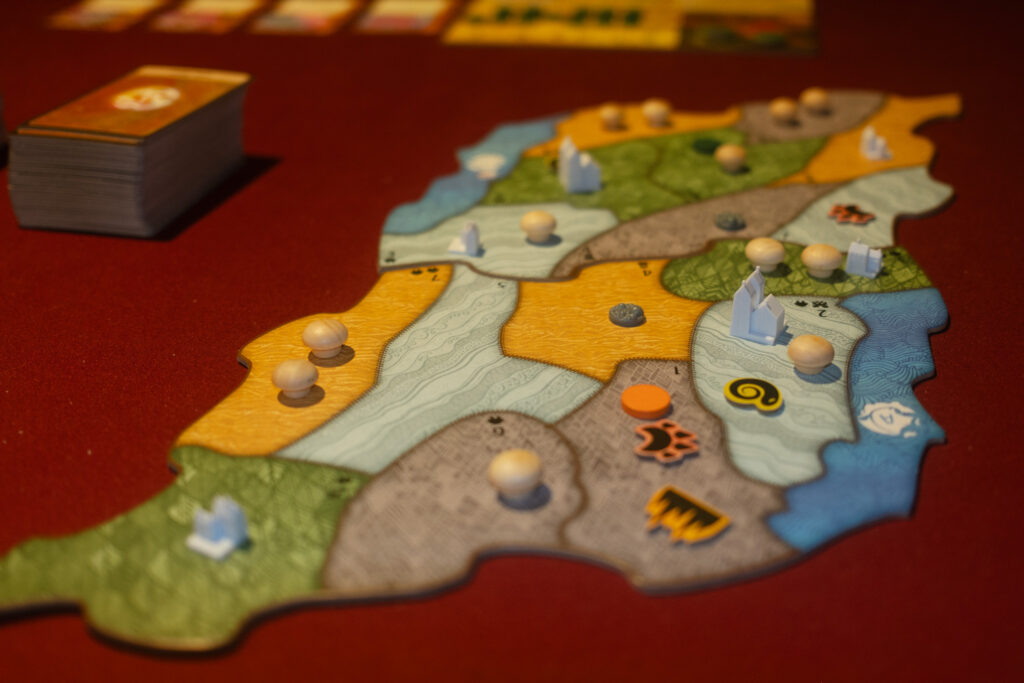
During our first game of Spirit Island, I was a kid enamored with the feeling of discovery. I situated myself in a world I knew nothing about, but was tasked with saving, and that narrative moved me right away. Spirit Island assumes the players are capable—there’s actually no choice to not be capable—before helping them grow in their capacity to fend for their unearthly lives. As we read our powers and cards aloud to each other and strategized how to try and eke out a win, there was a felt sense of things beyond our immediate understanding clicking together. A few turns in and I was able to gather how pushing a Dahan into a land that will ravage during the Invader phase, and defending that land just enough so the Dahan could fight back during said ravage, would then plink off the offending town and generate the one fear we needed to advance the win condition to the next level. These detailed plans waterfalled down on us as we tried to solve the dynamic puzzle of this crunchy game.
By the end of that initial play, I knew intricate details about a world that was otherwise nonexistent to me two hours prior. I had a wholly unique, entirely unexpected tactile experience contained in a medium-sized box. Spirit Island demanded the best of me—calm, meticulous, calculating, and collaborative—and it was easy to give the game a version of myself I didn’t know I could so readily access. As an avid reader and video gamer, I found that hobby gaming clawed at a different, more active part of my psyche. It was the escapism of an epic fantasy book and the all-powerful sensation of a video game, propped up by the active, off-rails decision space I had never known in another form of art. My decisions during play made the art meatier and more impactful. Play, I realized, could turn me from a passive observer to an architect of adventure and fun. My choices during the game shaped the story at our table as much as the story on the table shaped my decisions.
Play is a waltz. Sure, I’m moving little mushroom-shaped wooden pieces and some disks that we’ve all agreed are my spiritual essence around a colorful board, but look past the silliness of framing things this way to see what makes play so multidimensional. It’s the compounding agency, where every thought cascades into the next and the consequences of any one decision transforms our shared experience long after we pack that game away. It’s similar to the way an album imprints upon a listener because of where they were in life at the time of hearing the record. In the case of music, that sort of ethereal, slow-churning change takes time and repeat listens, but with games, the narrative and the memory emerges near-instantly. They shape each other. Winning and losing becomes secondary to what we talk about when we leave the table. My little family still brings up chanting, “One fear! One fear!” over six years removed from that initial game of Spirit Island we botched. That’s what makes play beautiful and essential to living well.
Play, I realized, could turn me from a passive observer to an architect of adventure and fun.
Donna C
Spirit Island, for its part, is deemed a “serious” game. It’s genre is referred to as “crisis management,” and it’s true that a game of Spirit Island is basically a “respond to bad stuff” simulator, but in thinking more deeply about the physical act of play, I’ve also been able to develop silly shorthand for cards, spirits, and the elemental icons in the game. Little twinges of my and my table’s personality color my read of Spirit Island and let it be a little funny. For instance, the air element looks a bit like a purple chili pepper. My table hasn’t called it “air” in years. Every round, I read the text on Event cards with a funny inflection to my voice to ease the pang of getting awful news and having our plans spoiled. My favorite spirit, Volcano Looming High, kind of looks like a feral cat. Whenever I trigger its innate ability to erupt hot lava and destroy a gaggle of pesky Invaders, I announce to the table that, “I am cat.” The game would feel otherwise naked, severe, and brittle without these inside jokes. Forming and nurturing them proves that play begets play and fun can snowball into an ecosystem.
These sweet elements make it easier to swallow that gaming is about not knowing as much as it is about drawing up our own stories from play to play. At the start of any board game session, whether it’s my first play or my thousandth, I am signing up for things that otherwise nettle me in real life: being wrong, making mistakes, and ceding control. To enjoy Spirit Island I’ve had to become comfortable with not having all of the answers all of the time. While ultimate understanding and a growing swell of knowledge are both fantastic shields for an anxious person, they don’t always mean much when your fate is decided by shuffled cards in a random stack. I wrestle with this as someone who likes to logic away their emotions. Reaching for control is an automatic response I’ve had to learn to shut off to be able to do something as seemingly small as play a game.
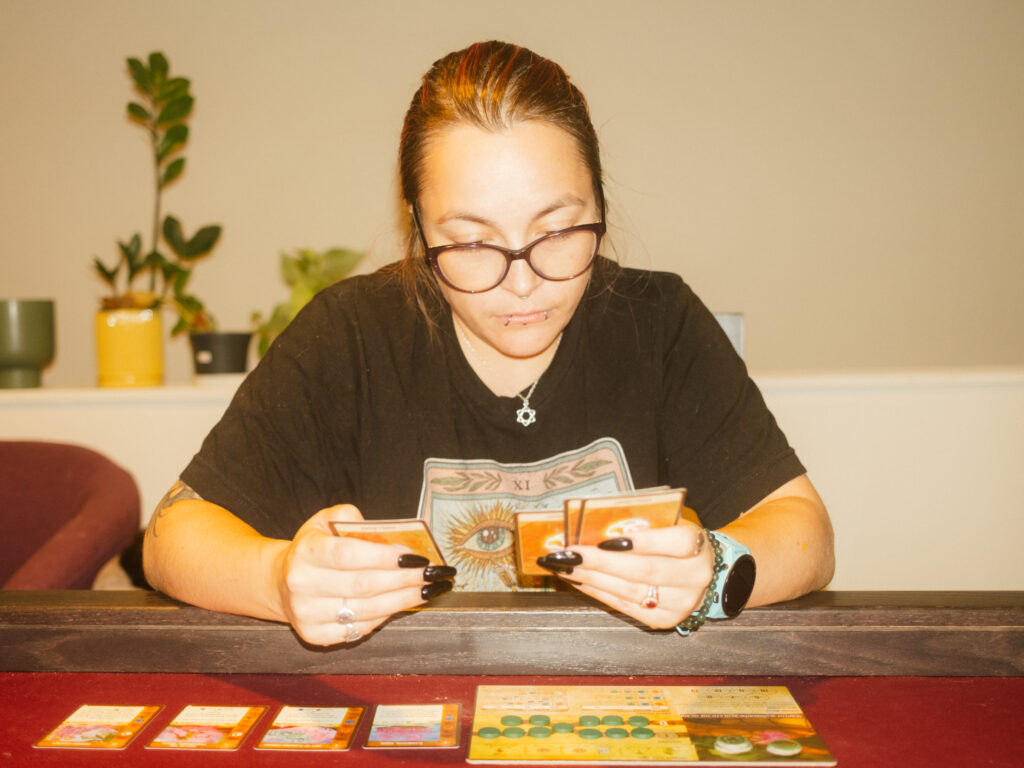
With that, Spirit Island becomes a space to practice positive, “What if?” thinking. Consider this: After over 1,000 games of Spirit Island, I have most of the “bad stuff happens” cards memorized, including the smaller good things those cards can bring with them. With all my experience, I have the capacity to look at those face down cards—the Event deck—and the board, and decide to trust that something good just might come up if we let the game, game. Sometimes, I choose to trust the game, and we flip over the exact Event card that turns the beast tokens on the board mad with power and they kill off the final buildings, and we win before we were slated to lose.
There are also turns in Spirit Island where I’ve felt so unbelievably powerful heading into the Event phase, only to flip a card and have three cities and a town full of Invaders show up and threaten my island board with man-made blight. We’re on the cusp of losing, and it might very well be my fault, but that’s also what makes play amazing: I’m allowed to be wrong. I’m encouraged to try and fail. The flow of play rewards risks and being a little more flippant than I would if there was a real-life tragedy unfolding in front of me. A game of Spirit Island is eminently more fun when played with an unclenched jaw and room for the game to put out its own flower spikes. Some flowers are beautiful, and some are poisonous, but I don’t play board games to achieve perfect outcomes—even that admission feels radical—I play them to be present.
So, the rapid proliferation of little plastic blight tokens on my precious island board feels catastrophic in the game-moment, but those gray disks have no actual impact on my real-life health. While games themselves can be tugs of war—and it is true that “tug of war” is also a genre of two-player game—the material impact of play is almost always positive. Yes, I can be upset that we lost, and I can be angry that two turns prior I didn’t draft a more apt power card, but that frustration is never greater than the benefit of having experienced the game. Spirit Island is not structured around absolutes, but board gaming in general has some guardrails to how negative outcomes can impact our lives. That is, they don’t necessarily shape them in the same way positive ones do, and in that way, the lasting benefits of play is one of the few guarantees we have in life.
All of these benefits came to me after tens, of hundreds, of thousands of plays, with just as many rulebooks digested, and unique nuances of games learned. Before I got to reap any of the emotionally resonant elements of gaming, though, I had to first let games teach me to virtues of being bad at them. More than paying the price for poor judgment calls during play, learning how to suck at games was vital to having real fun. Holding my starting power cards in my hand when trying a new Spirit Island character, not knowing how they fit together, plodding through decisions that just didn’t line up, and feeling regret at strings of inopportune plays, has helped me humanize myself.
I have since understood that no one is born good at anything, including any one specific Spirit Island character. As much as I romanticized the idea of being a prodigy in my childhood, the more human path of being pretty bad, then being sort of okay, then being passable, and so on, has a lot more meat to it. Being bad at something is exciting and rewarding. Opening the door to poor play is better described as setting out on a journey of discovery. It’s not that I am bad at games; rather, it’s that I get to learn, discover, and grow as a player. In that way, play condenses and imitates much larger life projects into 45-minute sessions. It trains me to appreciate the grind.
Now, it’s miraculous that I’ve come this far without blatantly stating that gaming is a mirror—and it is—but more than a mirror, which is otherwise flat and takes some agency away from the viewer, play is a vessel for change. If on a smaller, contained scale, I can grow comfortable and confident being bad, and embrace that first blush of mistakes and misplays as the jumping off point for mastery, I’ve achieved something that in my real-life, I’ve spent decades trying to pin down. That is, games are proving grounds. Testing chambers. Petri dishes. You name it and it’s probably an apt metaphor for the way presentness and play can help reframe our relationships to all those esoteric things we start chasing in our late teens and early 20s.
I view my life as a series of projects at varying stages of completion, with the ultimate understanding that nothing is ever finished. Rather than feeling like Sisyphus on a bad day, I have grown to be able to smile while shoving my boulders up mountains. Learning to play—whether it’s Spirit Island, or some other game—has given me the tools to fully appreciate being a person. When I work through the mundane traumas that people my otherwise average life, I graft them onto their gaming analogs. I deal in metaphors and context, and those techniques help me cope and move on when I’m pelted with bad health news or something similarly disruptive. Play is what I do, but it also the lens through which I see the world, and it has given me so many more tools for interfacing with pain and challenge. I am a better, more complete person for having opened the box, set up the session, and having played.