This is the third post in a series of posts about my relationship to Spirit Island and how gaming has improved my mental health. You can catch up on all the posts here!
Surprising no one, I don’t participate in calculated risk-taking. I am, by all accounts, a scaredy cat. I don’t bring my weather-sealed camera out on rainy days. I don’t always trust labels that promise things are “dishwasher safe.” Just because I can take a risk—it might not even be a real risk—doesn’t mean I should. In almost every scenario, I’d rather go the long way just to be safe, even if the long way is riddled with stinging nettle and I’m already exhausted, and there was nothing actually safe about the journey traveled. In the pursuit of making myself feel less anxious, I make life harder.
Board games don’t want me to take the long way around a problem. There is nothing fun about setting up a game and playing conservatively. At the table, I’ve learned to put away my endless trepidation. It’s taken me a few years, but in the scope of hobby gaming, if there’s a risk worth taking, I’m suddenly all in. Play encourages risk-taking. The self-contained nature of a game of Spirit Island, no matter how important it may feel to the fabric of my real life, begets my growing flippancy at the table. I can be as meticulous with my moves as I want, but sometimes, the real joy and the stories that last beyond the session come from accessing parts of myself that are otherwise dormant in my day-to-day life.
One of the most chaotic Spirit Island player spirits, Grinning Trickster Stirs Up Trouble, is built around risk-taking. It has an innate power called, “Let’s See What Happens,” which plays exactly as you might expect. With the right elements stored up on a given turn, as Trickster, I can choose to cede all manner of control to flip a power card at random on a target land in hopes I pull the one card to deal with all my Invader problems. If you’re having an optimized Trickster game, there’s a chance “Let’s See What Happens” is being triggered every turn, changing the flow of the game from a series of best laid plans to a string of leaps of fate.
“Let’s See What Happens” microplanes off my desire for determinism in favor of delicious uncertainty. The ability exists at the intersection of identifying a problem I’d like to solve, and attempting to will said issue to take care of itself by staring deeply into the face down pile of cards. Here’s that positive “What if?” thinking in action. The thin veil of control I’ve draped over myself gets shredded as I flip over a power card from the towering pile and hold my breath each turn. Spirit Island disarms me in these moments; I’m willingly at the mercy of randomness. I embrace the unknown and make it the fulcrum of my plans. Behind each of these risks is a wish sealed with a drop of hope. Trickster’s design works so well because there is always a chance the one, two, or three risks I take on a given turn will pay dividends. They might even win me the game. No promises, of course, but the possibilities here sweeten the game play just enough to make the risks themselves irresistible.
Play encourages me to never give up, even in a moment of slim opportunities.
When I first started figuring out how to play Trickster well, I spent a lot of time milling through the deck of Minor Power cards before casting “Let’s See What Happens.” My goal was to be able to calculate out how dangerous “Let’s See What Happens” might be in a given session—and then I realized I couldn’t store a hundred powers in my mind. Even if cards that add blight are already in the discard pile, the reality is, there’s a bunch more that do the same thing and this layer of board game calculus doesn’t exactly fit the spirit of play and chance. Piloting Trickster is a question of trust. To have the best experience with that spirit, the game asks the player to believe in its tuning, and in their own ability to let go and have fun. The more I invested in learning Trickster’s design and how to play it well, the more I saw that its balance rested atop the inflection point between the known and the unknown.
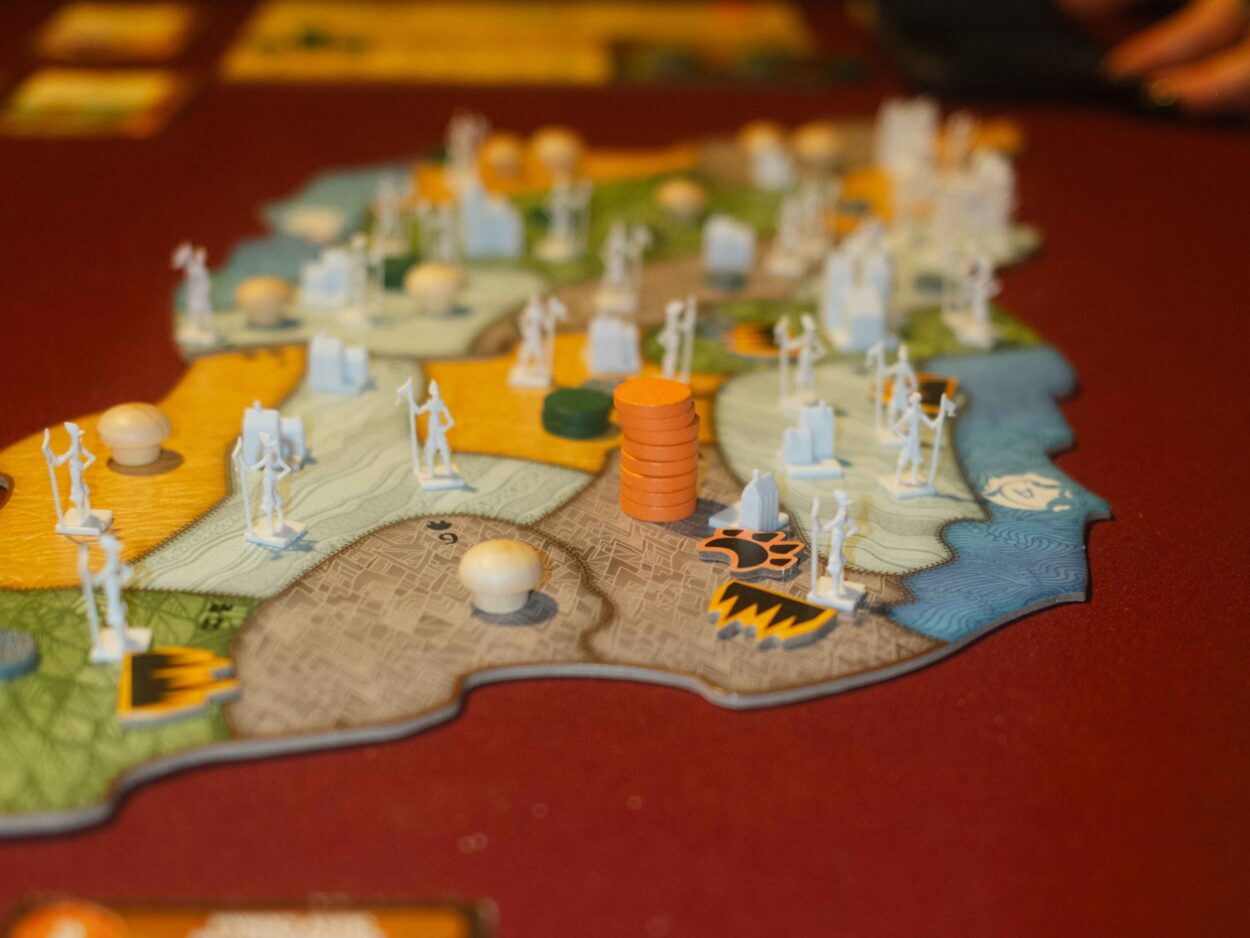
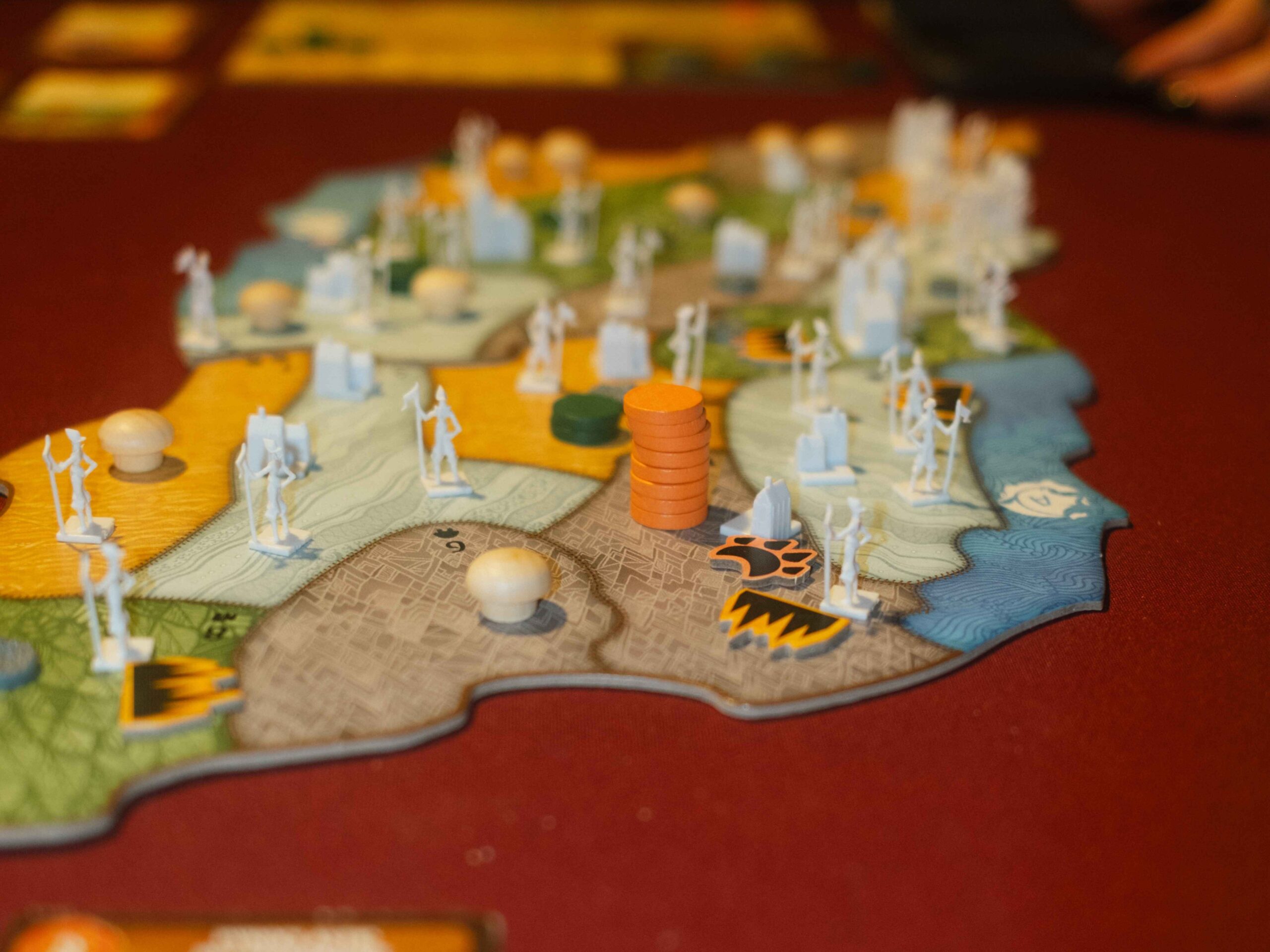
You see, the other facet of Spirit Island that Trickster excels at is adding Strife to the island’s Invaders. These little blue tokens literally disarm the bad guys, and make them unable to damage the native Dahan, as well as unable to blight the land we are protecting game to game. This mechanism is a temporary snare, and it goes down as oddly soothing. I can trigger “Let’s See What Happens” on a land covered in snared Invaders, and the random card I pull can do absolutely nothing to help me, but that land will still survive beyond the Ravage phase.
I think of the Strife tokens as a safety blanket. If I’m hesitant to take a risk, the presence of Strife ushers me along. Yes, causing Strifed Invaders to deal damage to their brethren is Trickster’s main means of controlling the board state, but Strife itself is my main means of not feeling like the game is entirely out of hand after the first turn. When I look at the sea of blue tokens, which I can easily spread by paying an additional in-game currency known as “Energy,” I can visualize a life for my island beyond the current threats gnawing through my supply of blight tokens. Still, there is always a possibility something dazzling might happen if I survive for just a second longer. The session becomes less about playing to win and more about playing to—you guessed it—see what happens.
In truth, being precious about each and every in-game decision grinds play to a halt. There is such a thing as thinking too hard, and I don’t want to turn play into a series of plodding choices. I come to the table to escape those trappings of daily life and to find the fluidity and flow that otherwise gets lost in the mundane. I sometimes feel like being run through the cogs of daily life leaves my colorless. Through play, I’m given the chance to scribble over an outline of my being with punchy neon markers. It’s taken me years to welcome in this perception of life, and more years still to enjoy what a spirit like Trickster has to offer.
I know now that more than half the roiling fun of gaming comes from heightened moments of uncertainty and watching their consequences spill out across a fictitious world. These breathless seconds, where cards are half turned face up and everyone is calculating out the best and worst possible outcomes, are the pinnacle of the hobby. So what if at least half the time I curse the card I pull and hiss after reading it aloud? That’s actually the cue for everyone at my table to have a big belly laugh. Every risk I take, no matter how it shakes out, has the opportunity to tell a complete story in just a few seconds. I fire off “Let’s See What Happens,” and whoever is with me immediately leans in until they’re pressed against the wooden table rails to witness the chaos.
There’s a tension and rising action baked in, which helps imprint each Trickster play session into our collective gaming minds. These risks help craft meaningful narratives and crystallize lasting memories. Winning and losing become secondary to how these stories are load-bearing for the way I experience companionship and share with other people. Each game as Trickster is paginated in my mind not by my success ratios, but rather, by the inevitable moment we all laughed until we cried. I have lost so many games as Trickster. Playing solo, I’ve only ever won two games as the spirit. You could call me “not very good,” and I would agree, but Trickster has helped me stray from measuring my enjoyment of a game against my win-loss record.
I’ve long since stopped playing to win. I play to—above all else—laugh.
There is no other setting in my life where I’ve ever agreed to just “see what happens.” Only at the game table do I take wild and fearless swings, especially when knowing that the odds are stacked against me. Sometimes I “see what happens,” and it ends the game of Spirit Island immediately by adding the final two blight tokens and triggering a deflating and unceremonious loss. I refer to this as an, “If I had known that would happen…” mistake. In the last few years, I’ve come to the conclusion that these aren’t mistakes at all, but rather, the cost of doing gaming business. They are a reminder that in life and in games, very rarely does thinking of what I should’ve done lead to useful thoughts or conversations. What happened is what happened, and my reaction to that reality is what matters.
So, I’ve cascaded three blights across my island board, instantly losing the game, instead of pulling a fabled card to eradicate the final city and win the game. This happens a lot. In those moments, the question becomes, “Can I let the game be the game? Can I laugh about this?” Laughing is the hardest and healthiest thing I do, and in gaming, I have plenty of opportunities to decide to live with a lighter touch. It has to be funny that my task as Trickster was to protect the island, and instead, I’ve made an irreversible mess of things. Spirit Island teaches me that both cosmic and situational irony can be delightful. To access my most formative emotional moments, I first have to cobble together these daily decisions to find it pretty funny that I narrowly escaped defeat for an hour, only to make a play on a whim and send the game back into its box.
To live well, I constantly root around myself, looking for ways to balance out not taking things too seriously with being deathly intent on achieving something important. Playing Trickster airlifts that challenge out of my daily life and places it square into a safe and contained space where giggling is encouraged and there’s no need to actually do anything “right,” for the worst thing that can happen is I have to put the game away earlier than I’d like. Besides, I can always play again. Few things are ever as dire as they feel—gaming has taught me to see past the thick line of self-determined catastrophe. If I think everything is the worst thing to happen to me, then naturally, everything is actually fine. Big feelings don’t always imply big outcomes. Walking into the worst-case scenario does not have to spell The End.
Massaging out this anxiety has taken over half a decade. Running face-first into danger as a three-headed furry creature who lives in a tree and casts chaos across the land for fun has been instrumental for my mental wellness. It’s rewarding to have a dedicated space to practice being what I otherwise think I am not in life. The surprises comes from the card flips, yes, but they also come from me impressing myself with how rash I can be while gaming. Quick turns, little thought, playing as if I’m part bull’s blood—none of these things are characteristic of how I see myself, but they are obviously a part of me. It’s easier to discover and nurture dormant bits of myself in an environment that is both meaningless and tuned to reshape who I am over consistent nudges in new directions.
Play turns me into a little maniac. I cackle until I can’t breathe. I play the riskiest card in the worst position, and gasp if I somehow survive. I lose a lot; I never learn my lesson. I devise optimal Trickster plays and blow them up within seconds. Sometimes my plans are razed on purpose, but most of the time, the degradation of the board is an accident. I suck at playing this spirit, but it has never once felt like bashing my head into a wall. Instead, I am running at fear, bursting through it, and finding a new layer of my humanity on the other side.