In gaming and in life, there are thresholds I cross through that paginate who I am and who I am becoming. Stepping from one gate to the next, there’s a moment of in-between where I’m able to fully take stock of my journey thus far. Noting and appreciating change helps me see life not as an endless spill of hard work, but as a long and winding walk in the woods. I spot change in all the little crevices of the things that make up my conception of myself, and that includes what games I am learning and playing.
In the hobby, there is a concept commonly referred to as “gateway games.” This smattering of games is typically lighter and simpler—think of them as games anyone can play by themselves or with a competent teacher at the table to guide them through the rulebook. These games are snappy and prioritize fun decisions and table talk. Whether intentional or not, a good “gateway game” encourages new players to wade deeper into the hobby. At which point the “gateway game” itself gets discarded for games with more meat on their bones.
Pandemic is a well-known gateway game precisely because it is co-operative, tense but not painful, and easy to run and comprehend. It’s a tiny portion of loaded stew, packed with mechanisms that will become familiar to players as they venture out to other games, but is a game itself that is unencumbered by its own details. When someone tells me they aren’t sure if they like playing games because they don’t like feeling dumb at the table, or don’t like losing, Pandemic is the easy offer because we’re all on one team and everyone’s here to help, and no one thinks anyone “looks dumb.”
Introducing a new gamer to Pandemic tends to come with a moment of grand revelation for them after setup. A few beads of sweat, a small bundle of nerves, and then the new player realizes they don’t have to understand everything about the game world all at once, nor do they have to piece all the details and strategy together alone. This is a shared experience, a shared weight. The table is a hearth melting away the anxiety of figuring out what to do make of their player power, their hand of cards, the board state. When the new player realizes the inherent camaraderie and shared mental load of Pandemic and games of its ilk—Forbidden Island, Forbidden Desert, Horrified—their eyes light up and old rusted gears start turning. The fear of making a mistake and flicking a nerve of insecurity is swept away, replaced instead by the dormant excitement of being able to play.
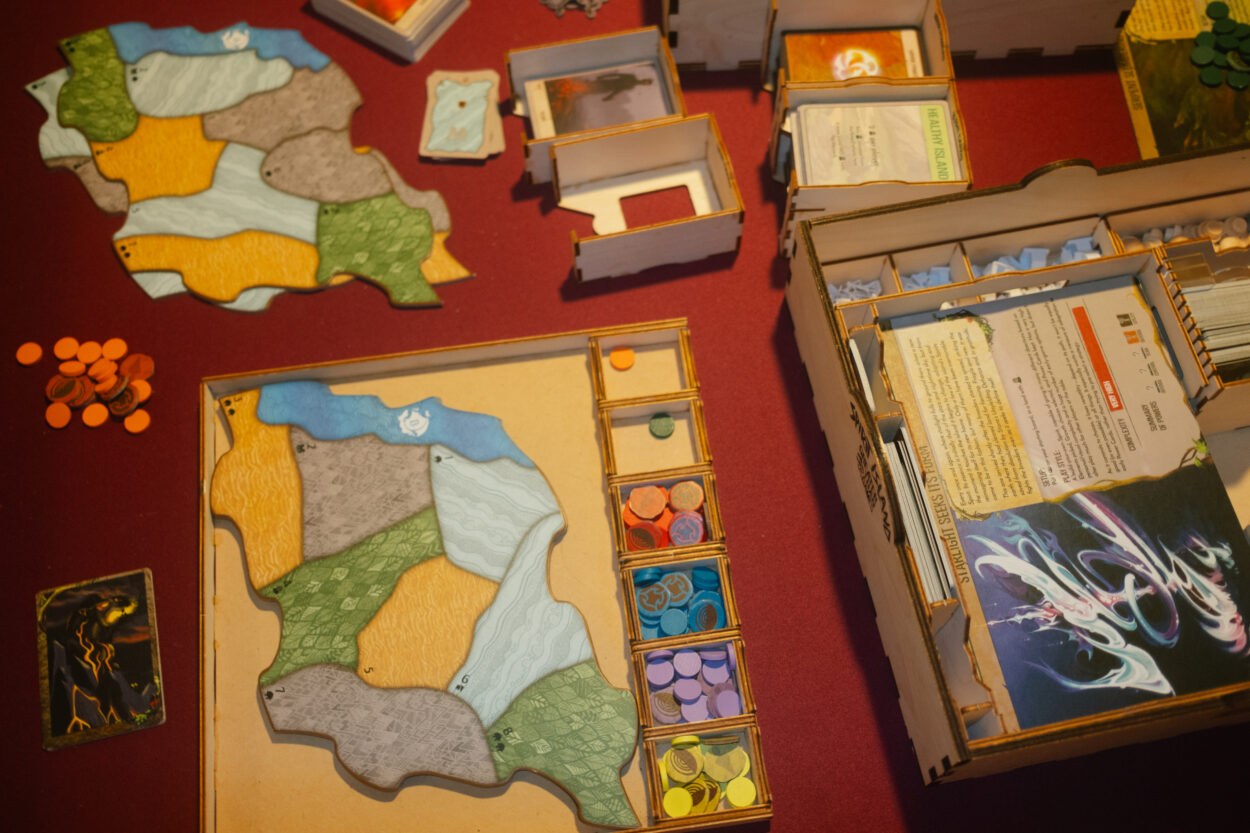
Pandemic was the only board game I owned until December of 2020, when my sister-in-law reached out to go in on a birthday gift for her husband: Spirit Island. She read that it was the best co-operative game, maybe ever, and he had expressed interest in trying it. That year, and every year thereafter, we were going to get together for New Year’s Eve to have champagne and eat a lot of cheese. Wouldn’t it be fun to give Spirit Island a shot all together during Cheese Feast, just like we did Pandemic? Maybe we’d even win a game this time. A few Venmo transactions and a quick search later, the box for the base game of Spirit Island arrived at our Philly rowhome a week before New Year’s Eve. My wife quickly wrapped it in Hanukkah gift paper from the local Aldi, and we put it in the corner of the living room until her sister and the belated birthday boy arrived to stay with us for the weekend.
I didn’t know at the time that buying base Spirit Island would help reroute the course of my emotional center, and while that does sound lofty, there is clear mark between the Before and the After of Spirit Island entering my life.
Donna C
The game is sometimes billed as the “anti-Catan,” because instead of colonizing a board, you play as the natural spirits of an undisturbed island that has a host of colonizers trying to build towns and cities in it, and you win by destroying them and striking fear into their hearts until they leave. Literally, your actions generate fear tokens, and when you pile up enough fear tokens, you earn fear cards, and sets of fear cards advance the win condition, and if you are swimming in fear, you just win outright.
Spirit Island is a game of settler destruction, as the box says, but more deeply, it is a game about learning how to manage a crisis and honestly talk to another person. It’s a game about balancing competing needs and making critical decisions as a team without feeling slighted. It’s a game about letting go of personal, short-term angst to experience the reward of serving the larger goals of preserving the entire island. Spirit Island teaches you to put yourself second whenever possible and to keep an eye on the folks around you.
The game is complex enough where no one can overtake the strategy and command the table. Instead, you’re up to your ears in body language cues when you finish planning your turn. You’re tuned in to every sigh, every furrowed brow, and every slump of someone’s shoulders as they plot out how to prevent the Invaders from blighting their island board.
Playing Spirit Island with other people introduces this elegant, though sometimes clumsy, dance of knowing when to offer help versus when to let a struggling player figure out how to rescue themselves. The game taps a special vein of communication that pumps through the inherent knowledge we have of each other at the table. Topping over 500 plays of Spirit Island with just my wife, I can sense what she needs based on the angle at which she sits over her power cards. This is the meta beyond the game’s meta. This is the whole reason we play games: to get closer. Where Pandemic showed me the inherent joy of gaming, Spirit Island was the game that cracked my skull open and let my brain slip out like an egg yolk meant to sizzle up for the greater good of becoming who I am today.
And still, tearing off the shrink covering Spirit Island for the first time was unceremonious. We punched out the cardboard energy tokens and marveled at the wooden pieces for the Dahan without knowing they were Dahan just yet. My brother-in-law flipped through the rulebook in that impatient way where he wished he could just absorb the rules through osmosis and play with intuition rather than actually having to read a full manual.
Once all the pieces were prepped, we each rifled through the low-complexity base spirits, and once everyone had their player spirit at the ready, we set up the game and bumbled through a round. My sister-in-law was River Surges in Sunlight, her husband played as Vital Strength of the Earth, my wife played as Shadows Flicker Like Flame, and I took the speedy route as Lightning’s Swift Strike. Our first few turns were riddled with caution and uncertainty, and our noses in the rulebook.
After 30 minutes, we got there, and the flow of play smoothed out and we started to see how each of us at the table could help the others. There was a moment where my sister-in-law, M, was hunched into herself, radiating despair, because she was going to have a cascading blight effect devastate her island board. There was nothing she could do about it during the early phase of the Invaders’ turn—until I looked at my cards and realized I could augment her powers and now we’ve got ourselves a game.
As a spirit, Lightning looks to be all damage all the time, but they also have a great support toolkit. Namely, they can allow other players to jump the line with their powers and cards that once could only be played during the slow phase of the game are then able to be played during the speedy phase. The tension that knotted up in M’s shoulders as she grew overwhelmed melted away the second I reached out across the table with a salve in the form of “Lightning’s Boon.”
Playing Spirit Island with other people introduces this elegant, though sometimes clumsy, dance of knowing when to offer help versus when to let a struggling player figure out how to rescue themselves.
Donna C
You see, our resource pool was drastically low on blight tokens. If a player needs to add blight to any board and there’s none to add, the game ends as the Invaders have mined the land for all it’s worth and the disaster flow of colonialism has defeated the spirits. In exchange for my island board taking a single blight, I was able to help M prevent three blights on her board. Math-wise, this action kept us in the game, but it also, crucially, kept M in the game. These crisis management negotiations are as much about staving off a loss as they are about considering the folks at the table and what they need to feel like we are all on one team and we’re going to gut it out to the very last card flip.
Over an hour into our game, the win conditions became clear and we realized the team was approaching the finish line. The four of us built up a strong-enough settler destruction engine powered by “Lightning’s Boon,” “Wash Away,” “Flash Floods,” and my buzzy electric bird spirit’s proclivity for destroying towns. By the end game, we were rolling in fear potential. Every time we generated any number of fear tokens, we’d all drop our cards and chant, “One fear! One fear!” This is the other thing about co-operative hobby gaming: it can be funny. As players, we naturally develop shorthand for icons, powers, phases, and so on, and we build up a language of tiny jokes to help overcome the gritted-teeth feeling of watching conquistador-shaped pieces destroy natural resources.
On the final turn of our first game of Spirit Island, we secured the last fear card and earned ourselves an instant victory. The elation after nearly two hours of cold sweat and fussing around these cardboard islands lifted all us up. And then, my brother-in-law fixed a peculiar look of confusion on his face, ducked into the rulebook, and announced that we had actually cheated, because he misread the timing on when the Dahan fight back against the Invaders. Our table erupted with laughter and I told him if we all cheat together, then we never cheated at all.