Some of these games are all time favourites of mine. Most of them are not. All of them show off some radically different way of thinking about games that people might not have seen before. That is why they make this list. They have the potential to crack open hidden parts of our brains brimming with curiosity to experience more of that sort of thing. If such marvels as these exist in the world, what else can we do to play together? They create wonder, desire, and by the time we get to the end of the list, we’ll start to see that they might just spark deep some kind of change inside of us as well.
10. Sprawlopolis
Accessibility is clearly what brings this one to the table. Button Shy has made a market niche for themselves out of literally wallet sized games that you can carry anywhere with you, and Sprawlopolis, one of their earliest classics, is still one of the best, for the punch it packs into just eighteen cards. I love puzzle games that ask us to weigh up competing interests. I really want to build a long curvy road, but if I’m only focussing on that I will lose sight of the other objectives, and will lose the game. Finding the action which most cleverly bends all of these objectives as close as possible to each other is a rewarding dopamine hit in the brain. I whip out Sprawlopolis on the train and people are instantly curious. What is this puzzly goodness that you carried with you in your pocket?
9. Dixit
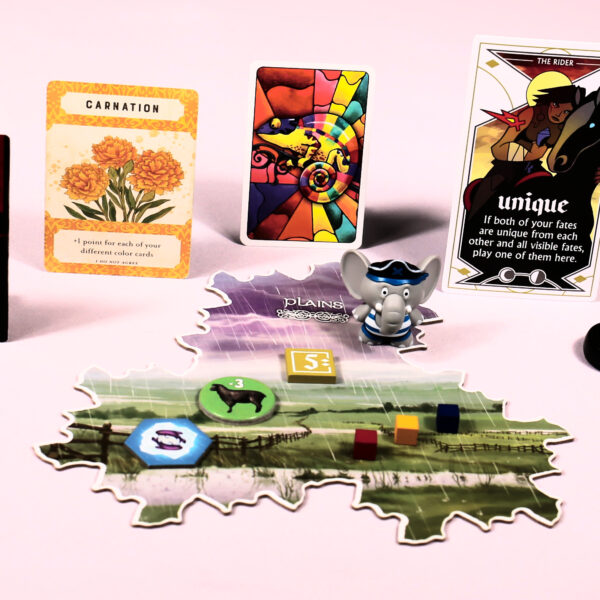
I know, I know. Dixit is old hat by now. But there are still so many people out there that don’t know that it’s possible to pull down a thick deck of tarot-sized cards—brimming with beautifully quixotic illustrations—and make such a charming social experience out of it. I use Dixit to pull people away from playing competitive games hyper competitively, to see the joy in just trying to understand each other as we explore each other’s weird symbolic minds. Often I won’t even score up the points, if the group is up for it, we just let the creativity flow. Sometimes serious, deeply personal, sometimes hilarious, sometimes silly, it’s always a hit with new people.
8. Mysterium
Mysterium follows on nicely from Dixit. If they liked the visually creative side of Dixit, but want a little more game, a little more puzzle, a deeper mystery, then we’ll graduate to Mysterium or Mysterium Park. It’s both a good introduction to cooperative games and it helps push people into new parts of the brain. Once again we’re trying to figure out how one of us thinks through ambiguous but beautiful imagery, but this time, there is a solemn sense of urgency and togetherness. Once the mystery is solved, or not, it almost always leaves new players wanting more. It tickles the desire to stay inside each other’s minds for a little while longer, and that is beautiful.
7. Root
The asymmetry that we opened up in Mysterium deepens. When I see that players are craving a more full board game experience, and are ready to challenge their brains with a few more rules, then we might move on to Root. Root shatters most people’s ideas of what a war game can look like. Not only visually, but also because of its core asymmetry. Most non geeks have never heard of a COIN game. But a magical woodland full of cute furry friends locked together in a devastating war? Yes please! It goes from playing with cute plushies to genocide, terrorism, and war profiteering faster than you can blink. The art and presentation is so damn accessible that it draws new players into a world of gaming mechanics they might not ever have seen otherwise. It’s provocative, it generates conversations. It changes the way people play games.
6. Nature
I think many gamers fall into a rut thinking that they will learn a game and then just apply what they learned turn after turn until the game is over and someone has won. I love games that make you rethink what the game is each and every turn. The rules provide a playground with which players dispute reality itself, turn after turn. I could easily have made number 6 be Arcs, following on from Root, but Nature is a much more accessible title. If I just stick to my strategy every turn, doggedly increasing the size and population of my species, tweaking a trait here and there — I will very likely lose to the player who looks at the complete state of Nature, spots an ecological niche that is not being exploited, and adapts hard to that new reality. Games like these can make us think about games and life itself, in a far more adaptive, creative way. They are literally power juice for our brains!
5. Nuns on the Run
I have never introduced Nuns on the Run to people and not have it be (a) an instant success and (b) a mind-expanding moment of what board games can look like. One player (usually me since I’m doing the introducing) plays the adults, the Prioress and the Abbess, and I march those two nuns around the Abbey after dark. All of the other players, young novices, are supposed to be in their cells but have all snuck out into the abbey to stuff their mouths with cake, drink laudanum, read the books about evil in the library, or retrieve a letter from their lover. It’s a hidden movement game, so I can’t see where the girls are, but they usually end up making a lot of noise, marked out with tokens, and if they pass in front of me then I do see them and try to catch them. It turns hidden movement deduction into a hilarious irreverent roleplaying experience, with lots of sternness, naughtiness, and laughter all thrown into the mix. Nuns on the Run unlocks our inner children and literally lets them run wild through the abbey. It gives us permission to be naughty, to transgress, and laugh. That is medicine to many modern adult lives.
4. Magic Maze
Magic Maze turns a lot of people’s expectations about games on its head. The real-time board game craze seems to be dying down a bit, but this was one of the better ones from that crop. We cooperate without speaking (though we can do a lot of passive-aggressive banging of the big red token). Each of us controls all of the adventurers, but only in one direction. We must coordinate and act quickly, because we have very little time, but you’re not seeing what I’m seeing and I’ve completely missed the adventurer you’re trying to get me to move on the other side of the mall. It’s chaotic. It’s frustrating. It could damage weak relationships and arouse fragile egos, but if we can get past all of that, then silently working together in this most unusual way creates an unforgettable and hilarious experience. It is a game that challenges us to face up to how we work together in new and unexpected situations. Do we get angry? Do we feel out of control? Do we do it with good humor? Are we ok with how we reacted in that weird situation? Do we grow from it? That games have the potential to bring all of this out makes them powerful tools in our personal psychological growth. If we’re open to them in that way.
3. Dorfromantik: The Board Game
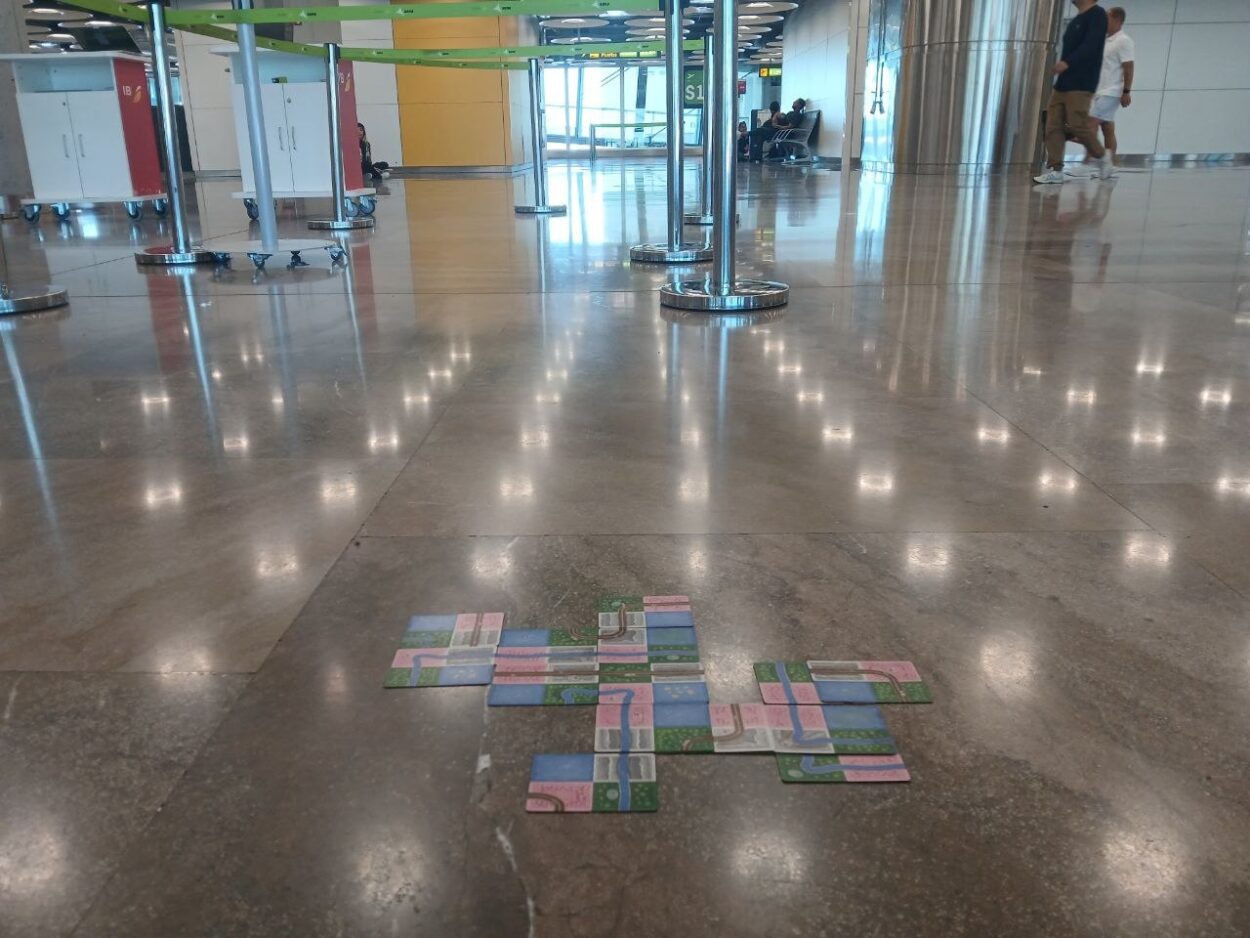
This is the newest game to me on this list, and I’ve included it because it takes the classic tile laying puzzle game and teaches us that it can be impossible to lose a game and yet still have it be a tight compelling experience. Dorfromantik latches onto the dopamine filled mechanisms of quick and easy digital puzzle games, swapping out old ideas about winning and losing for unlockable achievements and rewards. I was curious, but a little skeptical, and after my first game I was completely won over. What games are continues to be something that we challenge, break open, change and expand, and Dorfromantik is a delightful little puzzle that cracked open an old orthodoxy about what a board game must be. Once again, such a simple little change can transform how we think about life itself. Life is not really about winning and losing, and when we fall into the trap of thinking it is so, it usually makes us miserable. I think it’s quite interesting that our board games begin to break out of that stage of thinking, that it’s all about “winning”, and often at the expense of someone else. Dorfromantik asks us, what if it’s just about expanding and growing? You’ll never really lose, because you’ve always made some progress in some direction. That sounds a lot like life to me.

2. Earthborne Rangers
Ok, so I confess, this is one of the trickiest titles on this list, and another one that I have written a decolonial review of. The truth is, I absolutely love showing it to new people, and I also absolutely hate showing it to new people. Huh? I love it, because it expands so many things about gaming for many people who haven’t already dove down into the world of card games. Its world, its theme, its story is uniquely optimistic and compelling at the same time. The emergent story moments that it creates can touch cinematic heights that have moved me to tears, and to awe, and to jubilation. I’m not exaggerating. For me, it’s that good. If you haven’t heard of it, I don’t have the scope in this entry to do it justice, but you can see, if it has affected me so profoundly. Into its core are woven the values of respect for ancestors and Spirit, of believing that we can navigate harm in the world without turning excessively violent. That in minimising harm and making connections we can find other ways.
And yet it is a finicky rulesy game to teach, and almost everyone I show it to will not be in a position to carry on and actually play a campaign with me. So I love showing it to people, but I might be done actually teaching it, unless you’re sticking around for a campaign, in which case, pitch a tent and get a fire going, we’re going to be here for days on end.
1. Winter Rabbit
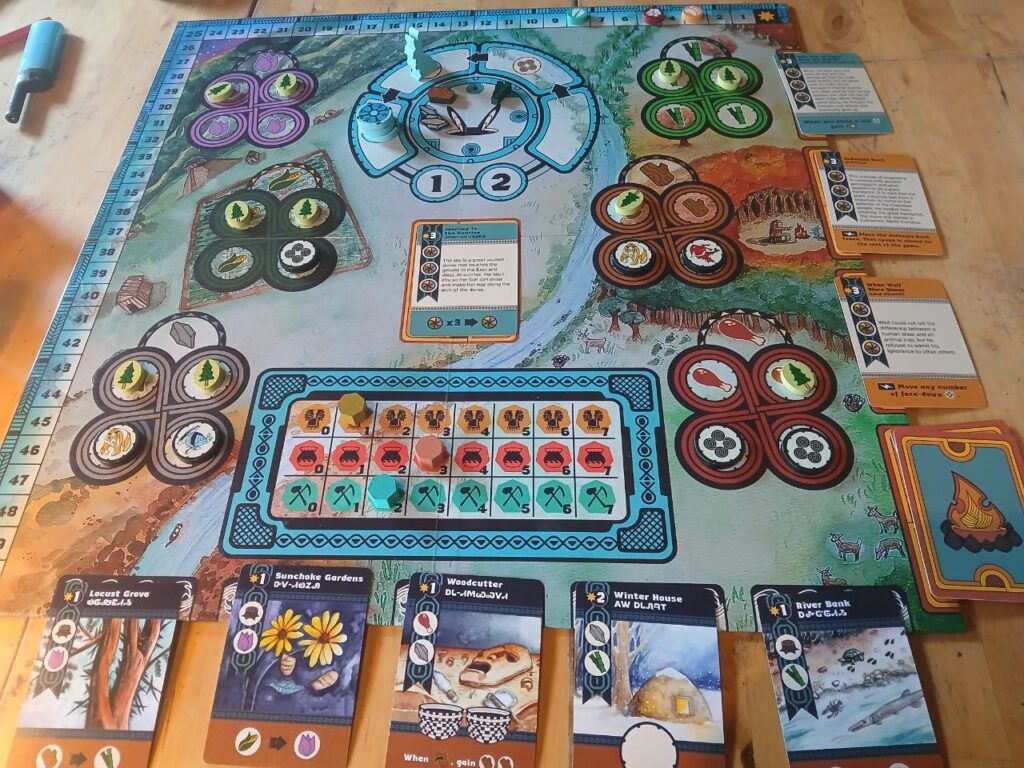
Winter Rabbit opens worlds in what games can do for us culturally. I have a longer (decolonial) review of it on this website. Winter Rabbit is Cherokee created through and through, and instead of just taking a popular board game format and steeping it in indigenous culture, as some other (also wonderful) Indigplay games have done, Winter Rabbit rethinks the way we approach games, who we are as players coming together, what kinds of stories we are telling, and what non European values are inseparably woven into those stories. It’s called a “semi-cooperative” game, but I believe it’s better described as redefining competitive gaming. Many indigenous cultures have important ludic outlets for competition, and in the moment, winning that game becomes the most important thing we’re doing, just never at the expense of the tribe itself. In my own culture, the Taino’s Batey performed a profound social function as well as being a game. Winter Rabbit asks us to compete in this way. We can be mischievous, we can be sneaky, we can most certainly try to win, but we should never lose sight of the fact that if we don’t ultimately keep together as a group, we will all lose. Winter Rabbit reminds us that there are other ways of understanding competition, play, that there are other kinds of stories, stories that can challenge how we understand ourselves in the world.
When games start helping us to become better, smarter, more socially minded people, then we have taken a good step toward showing people some truly interesting games.