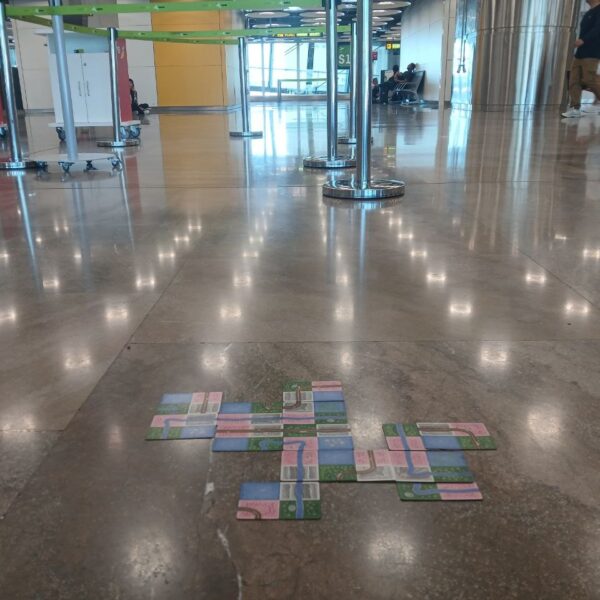
One of the (many) exciting parts of playing board games and hosting game nights is showing people games they have not played before. If I could only pick ten games I like to show people, these ten would be the ones, because they all have something special that really stands out and where I love to see peoples faces when they realize this magic.

Top 10 Games I Love to Show People
One of the (many) exciting parts of playing board games and hosting game nights is showing people games they have not played before. To an extent, this is for sure one of the things I love most about starting this blog as well, to show you some of the games that made an impression on me and that I like to show some love.
There are a lot of considerations when I pick a selection of games to choose from. Complexity and approachability is one of them, the player count for sure is one of the biggest aspects as well. How much time do we have, who is playing with me, and what games do they usually like? Are there specific styles or themes that are already known and liked, or a specific mechanism? Is artwork a factor, because let’s be real, games with cute animals often are a crowd favorite.
There are games that I often show people, and that are going over well more often than not. Some of them I want to sneak in here as my honorable mentions. Ethnos is a crowd-pleaser that scales great and has quick snappy turns, whilst Jixia Academy (Hanamikoji) is an emotional rollercoaster of a two-player experience. Through the Desert is a cutthroat game that is a classic for a reason, and Broom Service has a fluffy kind of tension that is really going over well, despite being a game where you really can outmaneuver yourself badly.
But if I could only pick ten games I like to show people, these ten would be the ones, because they all have something special that really stands out and where I love to see peoples faces when they realize this magic.
10: Hey That’s My Fish
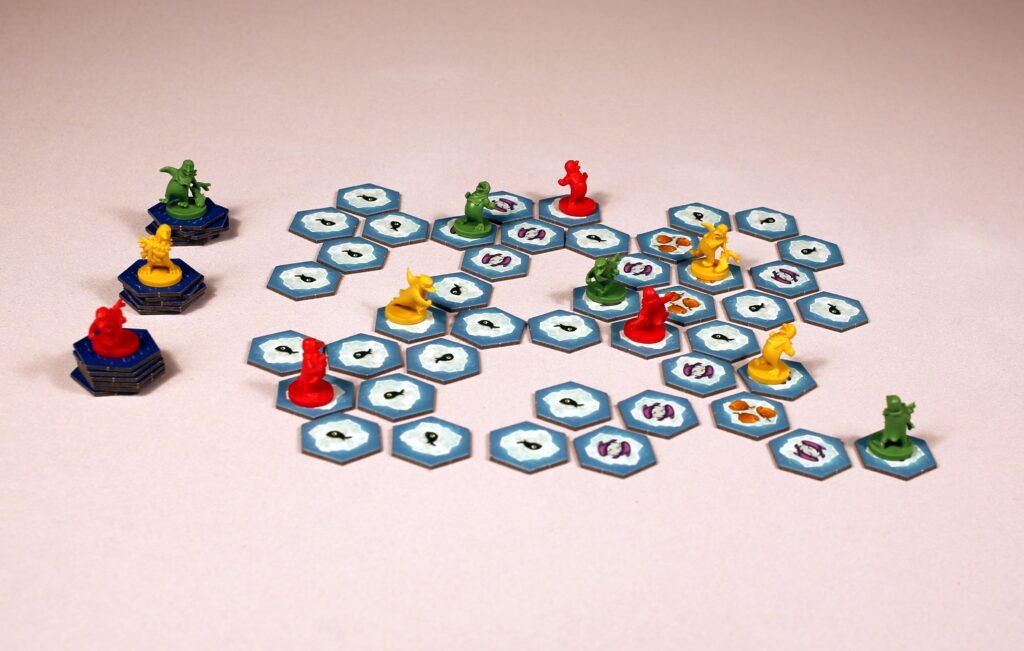
In this game, you share a board made of tiles, and can move around with one of your penguins at a time. When you leave a space, you remove the tile from the board, leaving a hole that is impassable from now on. The tiles are points (between 1 and 3), so you try to outmaneuver everyone else and secure the biggest cut for yourself.
This game is just a knife fight in a phone booth. Showing up as a 15-minute game in a small box and a goofy design about penguins, this gets loud and personal soon. You move around a shared board, leaving holes and broken dreams.The rules are really easy, and from turn one you are in each other’s faces. So this is not for everyone, but if you like this kind of tension, give it a try.
9: Coloretto
The first and second game from this list are from 2003, and this game also comes in a small box and packs a lot of tension in a short time. In Coloretto you either play a card into a row, or you choose to pick up all cards from one row. The cards are (mainly) different color chameleons, and bring you points. But only three colors (of your choice) are positive points, the others are negative points.
You are not taking enough cards or are waiting too long and creating a buffet of bad decisions – there hardly is ever anything else in Coloretto.
I love the easy rules, and the devastating decisions about timing and pushing your luck. Also it seems that it is surprisingly hard to have an idea what the other players will do, which oftentimes has a devastating effect on all of you. Still it does not feel confrontational, whilst living off interaction and every decision with the other players in mind. You can negotiate without saying a word by adding a wanted color to a row, or try to create a buffet of bad decisions.
8: The Shipwreck Arcana
The next game is the only cooperative game on this list (whilst Quirky Circuits came close to making it): In The Shipwreck Arcana one player draws two numbered tokes, and plays one of them onto one of four available clue cards. The others have to figure out what the number on the kept token is, and for this the chosen clue card might be less important than the ones not chosen.
I really enjoy the puzzly nature of this game, and the decisions and deduction thoughts are melting my brain in just the right way. It brings out a very talkative vibe (even in two players, I catch myself starting to talk to myself), and a sense of true cooperation in this hot mess of imperfect information. Because the rules are pretty straightforward for the deduction, this is very approachable and pretty unique in my collection.
7: The King Is Dead: Second Edition
I often struggle a bit to point out what makes this game so intriguing. It looks like a straightforward area control game, where three factions are vying for control, and it kind of is. But you are not controlling one of the factions, but instead have a set of eight actions for the whole game and try to navigate the power struggles. At the end of each action, you chose one unit from the board to add to your personal collection, and if you have the most units from the winning faction, you won the game (unless there are too many ties and other shenanigans).
This might be one of the most tense games I ever played. Every action needs to count, you play mind games with your opponent(s), struggle with the right timing and can’t decide if you want to do more actions early and put the pressure on, or pass and wait ’till an opportunity arises. You watch the table closely with every move, you nod in appreciation and despair at the same time, and you hope that your grand idea stays undetected. The community consensus seems to be that this is a 3-player game, but I love it even more as a head-to-head duel.

6: Crokinole
Crokinole is a two-player dexterity game, where both (there are also variants for 3-4 players) players flick wooden disks, trying to hit the center or your opponents discs. On your turn, you play a disc from your starting quadrant, and depending on the board state (if there are opponent discs on the board) the rules change. The rules are very simple, it has a classic feel (well, because it is), it has a great table presence, it and has a very haptic sensation.
First this seems like a good game to show people not into board games, because it has an activity vibe to it, but I love showing this to everyone coming over. Because Crokinole-boards are expensive and take up quite a lot of space, this is not a game that a lot of people have at home. I am not sure if I am just very bad for the amount of times I played this, but after a few rounds this is getting competitive / the scores are getting close, even for new players. I love setting up a Crokinole tournament at my birthday with random matchups and teams, to get people to interact with each other.
5: Bauernschlau
Bauernschlau is a highly interactive game from the early 90s. There are only four possible actions you can do on your turn, and you only do one every time, so the turns are very quick and snappy. You have to build fences with both your neighbours on a shared board, and place, flip or move sheep tokens. These tokens can have positive or negative value, that only the person placing them initially knows, and they can be moved once if they are not flipped.
This is another game on this list that is pretty cutthroat and where you are in each other’s faces basically from the go. Your priorities always shift and are highly dependent on what everyone else is doing. Your neighbour is building on your shared fence? You need to prevent them from encroaching too far into your farm. Someone is placing a sheep token on a multiplier spot? Better not giving them the time to flip it. Unless it is a bluff? You really can outmaneuver people in this game, but to be honest: pretty often you will outmaneuver yourself. And it is just fun.
4. Stomp The Plank
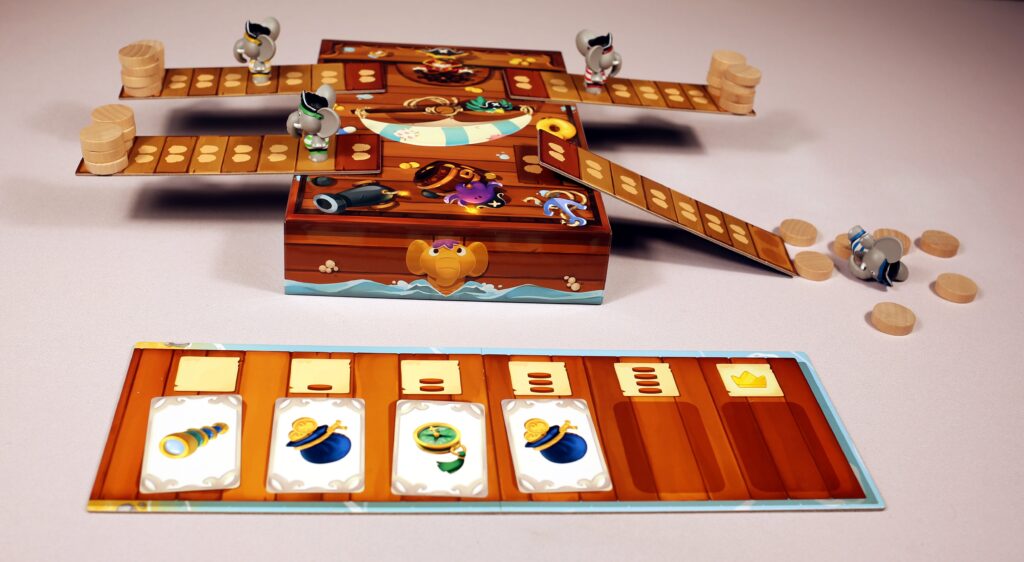
Stomp the plank comes along as a kids’ dexterity game with a push-your-luck-element. You each are an elephant, standing on a ship in front of a plank. On your turn you can flip card after card, until you decide to stop or if you get the same symbol on a card for the second time. If you stop, the other players have to put an amount of discs on the end of their planks, but if you bust, you must take a step forward on yours. The first elephant that falls down loses the game.
The very distilled push-your-luck-factor is providing a fast experience, and everyone is invested at every time. Stomp the Plank can be a buzzing experience when everyone is ready to enjoy the game, and is a game that is going over well more often than not. It has a desperate shoot-the-moon mechanism; it provides some significant decisions while also staying pure in its proneness to luck. And besides it being a kids’ game with a huge toy factor, I always played this with adults, and it provides a great time. Love having this in my collection.
3: Tussie Mussie
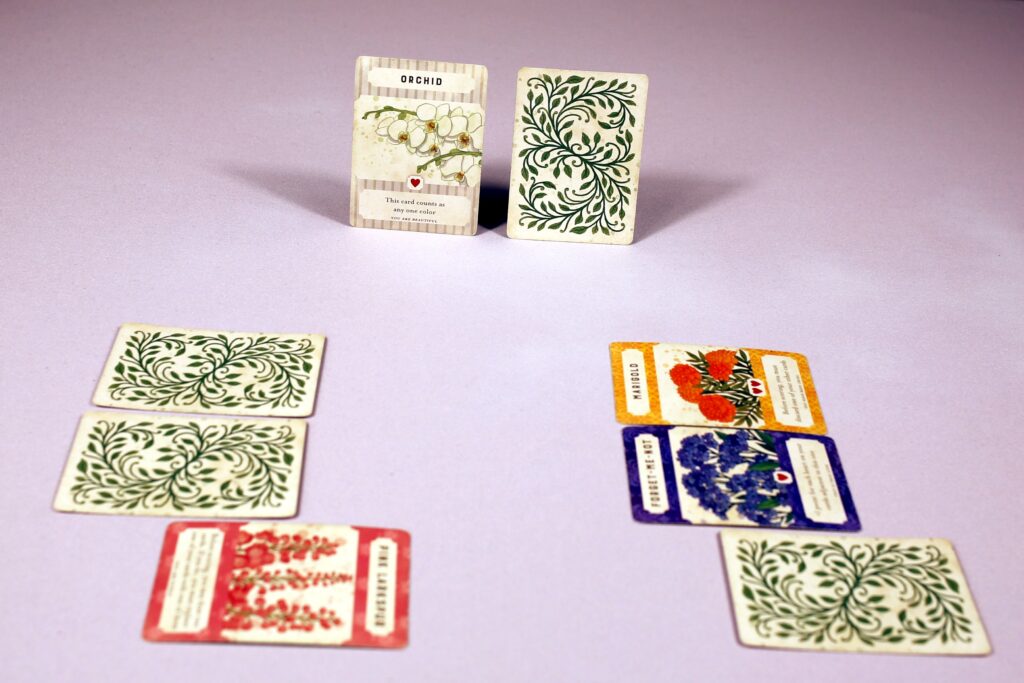
Developed as a classic 18-card-print-and-play, Tussie Mussie comes along with a few rules and a small set of cards. It scales up to 4 players and has a solo mode expansion, but I mostly play this as a 2-player game. On your turn you draw two flower cards and then offer them to your opponent: one face up, the other face down. After they choose, it is their turn, and when you both have four cards the round is scored. On the cards are different scoring rules, depending for example on colors or face-up/facedown status. After three rounds, the player with the most points wins.
There is no game that I took to more different places then Tussie Mussie. I often catch myself slipping this into my bag before leaving the house.
Because of its small format and required table space, this is the game I have played in the most different spaces (bars, restaurants, trains, or on bikepacking trips; I take it nearly everywhere). I love showing Tussie Mussie to people, and with the rarely used I-cut-you-choose mechanism, the beautiful illustrations, and short playtime, it is often a game that is played over and over. The tension and bluffing really entices smirks and a little bit of friendly banter.
2: Schadenfreude
Showing people different trick-taking games is something I really enjoy, and I could have filled up the whole list with those games. In the end I decided on Schadenfreude, which brings some twists that sound like the game should not work and is just pure chaos, but if you play it you get that there are a lot of nuance and smart decisions. And, well, opportunities to create chaos. The second highest card wins the trick, and you get your card and all non-lead-color cards as points. Unless you already have a card of this value already, then you lose it instead of gaining another. After someone reaches 40 points the game ends, but if you have over 40 points you lose.
This game is such a riot. Your goal always changes, because you want to get points, but if you are in the lead other people are motivated to give you too many points and you bust. Someone who has multiple cards to score can lose some of them during one trick, if everyone else plays the values that they have in front of them. You can control a lot of elements, but oftentimes you are at the mercy of your opponents. Oh, and did I tell you that there are cards with minus values? And sometimes, you desperately want someone to stick you with one of those. It is thrilling and tense, and the title is so very well fitted.
1: Inis
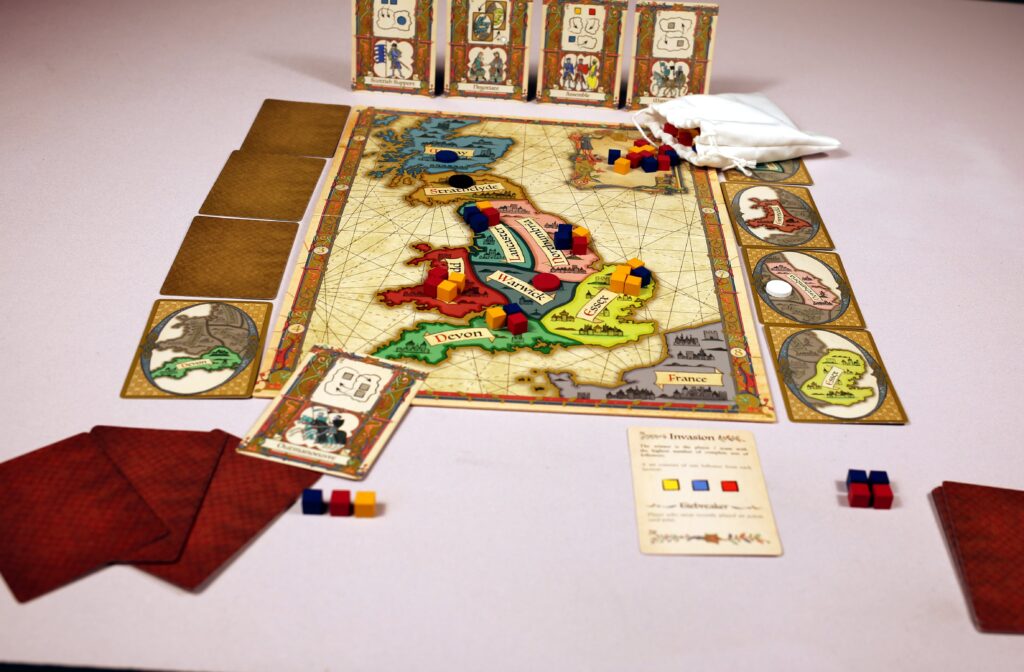
My number one is the longest and most complex game on the list, and whilst the rules are relatively simple themselves, because of the different abilities and possibilities this is not fitting the theme of lightweight games with cruel decisions (the cruel decisions part is true tho). Inis is an area-control game, with a focus on drafting and hand management. It breaks with the classic approach that you want to have full control over areas or want to spread all over the board through conquest. Timing is brutal in this game, especially because you can rejoin after passing your turn, and you have to keep your cards very close to your chest. You do not collect victory points, but there are three different goals you can achieve. But to win, you need to take a pretender token, so everyone knows that you want to finish this round, and all eyes are on you.
This game starts slowly giving you an idea what you can do, and then stakes are rising in a crescendo of tension, despair and smiles.
Even if it is quite stressful, I like the roller coaster of emotions and the tension. Especially if you have a plan to win, the last rounds can be super intense. The rules stay out of the way, and enable quick turns and loads of interaction. The core mechanisms are well established, but the combination and subtle twists create an experience I love. The modular and growing board creates high replayability, and I like the game at different player counts. There are some wonky special cards entering the game later, and the shenanigans are plenty. I am so amazed that a game is able to combine this feeling of magic moments, wonkiness and unexpected twists with such nuanced gameplay that provides you with lots of different possibilities and control. You can play it on a weeknight, and it still packs a punch and feels like grand strategy whilst being tactical at every heartbeat.