It’s not often that a board game has the potential to parent in a whole new style of game playing, and though Winter Rabbit, might not make as significant a splash as it deserves, it will create a whole new set of table top experiences for many of those that try it out.
Winter Rabbit: Indigiplay mischief and a non european take on competition
This blogpost is based on a decolonial perspective. Genuine curiosity and willingness to learn is welcome, but decolonialism itself is not up for debate on this blog. Decolonialism is a minoritarian approach and this blog is a safe space for it.
It’s not often that a board game has the potential to parent in a whole new style of game playing, and though ᎪᎳ ᏥᏍᏚ, or Winter Rabbit, might not make as significant a splash as it deserves, it will create a whole new set of table top experiences for many of those that try it out. Winter Rabbit is a semi-cooperative game set in the world of Cherokee folk stories for 2-6 players, though I’m gonna need to come back to that “semi-cooperative” label.
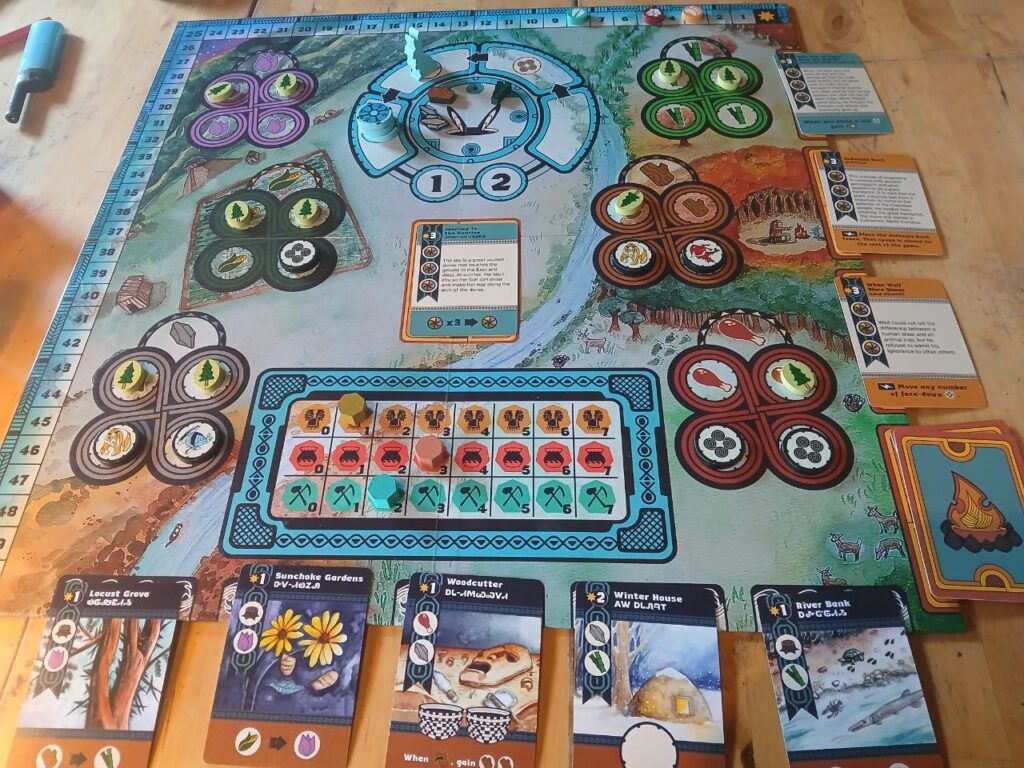
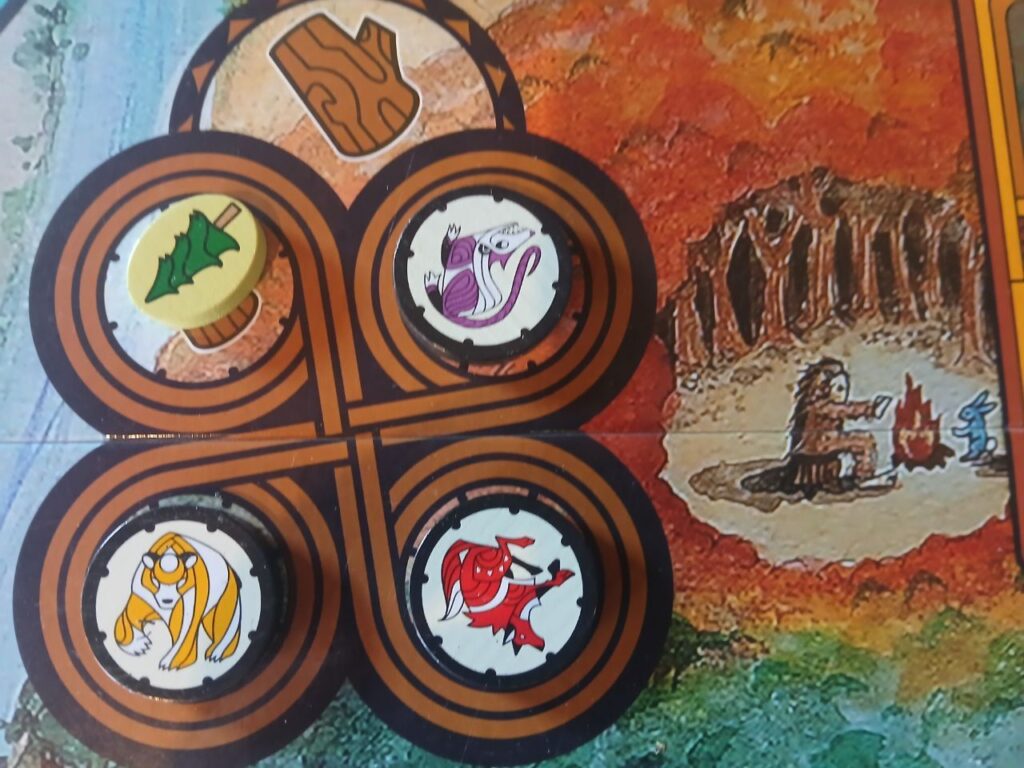
Winter Rabbit is set in a tale in which epic animals represent village members preparing for a foreseen catastrophic winter. Each player will take the role of an animal, such as Bear, Possum, Wolf, etc, playing villager tokens into natural environments to work together towards harvesting the natural resources necessary to fulfil each other’s tasks as they prepare for winter (you cannot fulfil your own task card). If the players, all together, manage to put away enough tools, food and clothing for the long winter then they will at least not all collectively lose the game, and then whoever has been seen to do the most in that grand preparation will be honoured by the village and will be declared winner of the game.
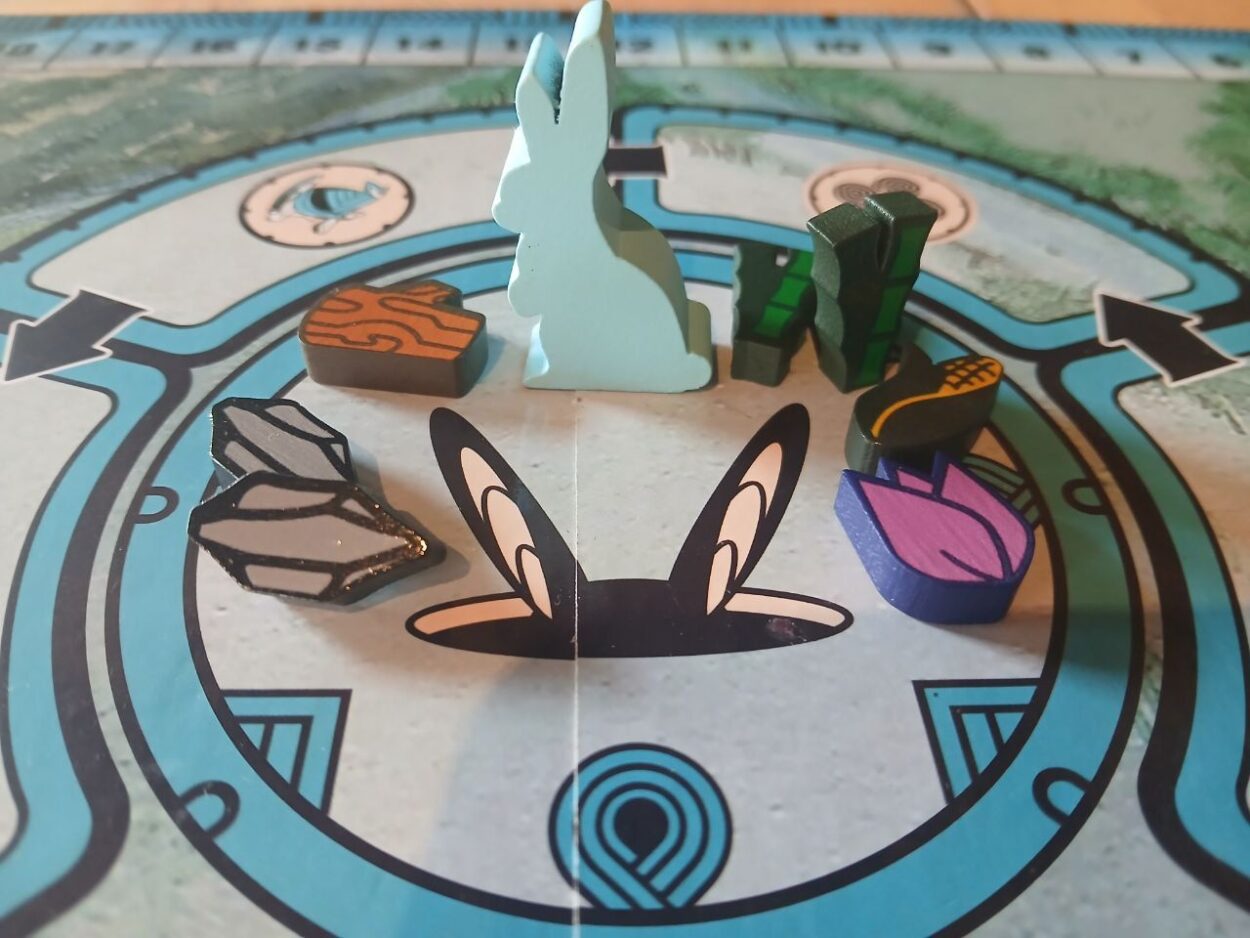
Additional game actions involve building a little individual engine tableau in the form of Village Cards, telling stories in the evening that potentially affect all players with an instant action or ongoing rule change, and crucially, trying to manage the eponymous Rabbit’s own village tokens, which mischievously scurry resources off to the Rabbit’s burrow.
We can’t go any farther without talking about who made this game, in what spirit, and what enormous implications that has. At its mechanical heart this is a resource management game, and I could easily imagine someone, grasping for one of the broad categories that we use, calling this “a euro game”. What a travesty that would be. Winter Rabbit was designed by William Thompson, a member of the Cherokee tribe, and the design is deliberately indigenous.
When I began designing this game, I intended to create an alternative to the problematic 4X — explore, expand, exploit, exterminate — game model. Throughout the rulebook, I’ve included sidebars as notes on how cultivation, conservation, continuation, and competition figure into the design. Instead of a true analog to 4X, this is an alternate model that is intended to reflect indigenous values through the mechanisms of the game.
William Thompson
Clearly, in an act of decolonial gaming joy, this game, no matter how many resource conversion cards you pile up in front of you, can never be called “a euro”. It fits into a new and growing category of games to rival euros and ameritrash: indigiplay. The structural differences to gameplay are not superficial, they really do represent a widening of our gameplay palettes.
Although the game bills itself as a semi-cooperative game somehow it has a different feel to many European designed semi-cooperatives. My own personal experience of European designed semi-coops is that there is almost always a hidden traitor, and it becomes a game of suspicion, betrayal, and disunity. In researching for this review, I discovered that there are three massive threads on BGG debating the semi-coop mechanic. I learned that, though hidden traitor games top the list of semi-coops in popularity (Battlestar Galactica, Dead of Winter, etc), many dispute that they truly are semi-coop, arguing that they’re really team versus team games with secret information. “True” semi-coops seem to turn away many for the uneven play experience they create. The top rated semi-coop game on BGG is Nemesis, a game whose secret individual goals ultimately unravel what starts out as a coop into the individualising realisation that really every one is fundamentally on their own.
Of course, the individualistic nature of European culture is a recurring and central critique of decolonial thought, and how we actually compose ourselves into groups, or how we understand our role in that group, and the relationships that it engenders, depends very much on our cultural background, and on colonialism.
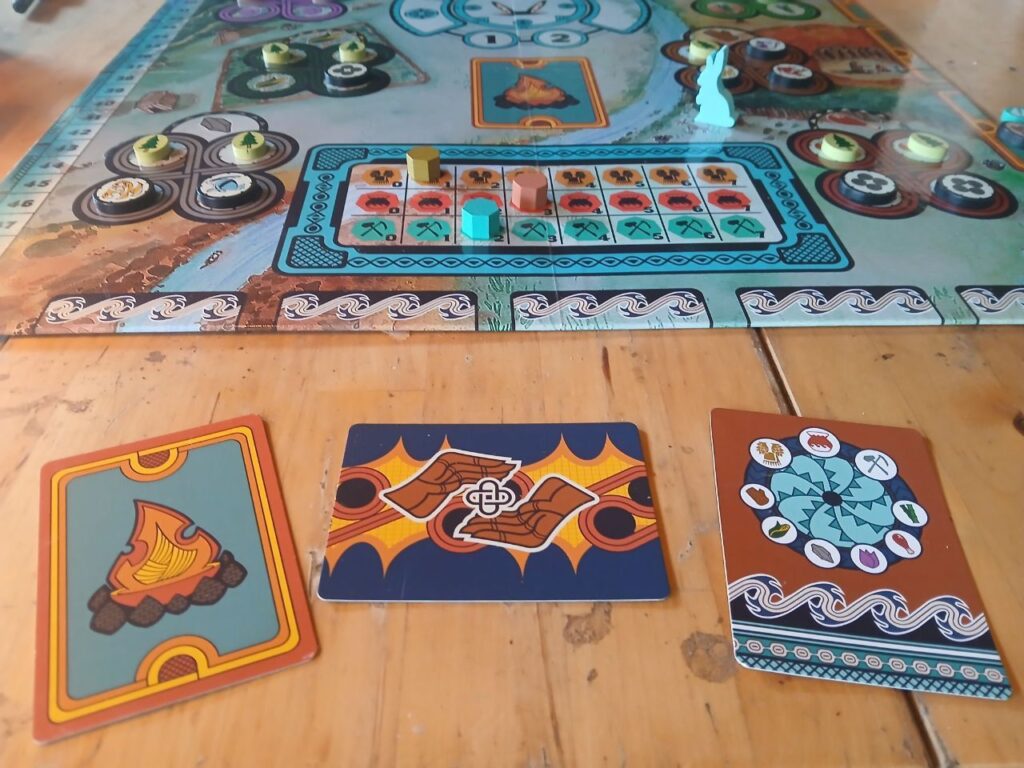
Winter Rabbit redefines what both cooperation and competition mean in board games. In fact, the designer writes in the rulebook:
Competition does not mean “winning at all costs.” It means striving for victory in a way that leaves your opponent with their honor intact. Our opponents today might be our allies tomorrow. Competition has always been strong within Cherokee society. Ball games, foot races, and contests of wits often stand in for more violent conflicts.
William Thompson
In this game we aren’t trying to exterminate our opponents. In fact, most of the actions that bring us towards victory actually benefit an opponent in some way. Instead of amassing wealth, dominance, or elimination, we are simply showing that we are the most helpful (and maybe bragging about it a little).
The games setting, and accompanying mechanics, certainly do seat us in a very different kind of game context, and in our plays, we found that gameplay had a different texture. Decolonialism should not be mistaken for a racist romantization of indigenous cultures as the pure embodiment eternal harmony, peace, and love. There is a lot of space in this game (and in many indigenous cultures) for enormous mischief and pranking, but at the end of gameplay, as Winter takes hold, you know that those you have teased and tried to beat, will be those that have your back. When we first unpacked it one of our players desperately wanted to be the mischievous Rabbit himself, which the game is not structured to permit. Their disappointment eventually gave way to an understanding that the game was set up such that the villagers can be mischievous with each other, but not to the point where it actually threatens the stability of our society. So no one can be the rabbit.
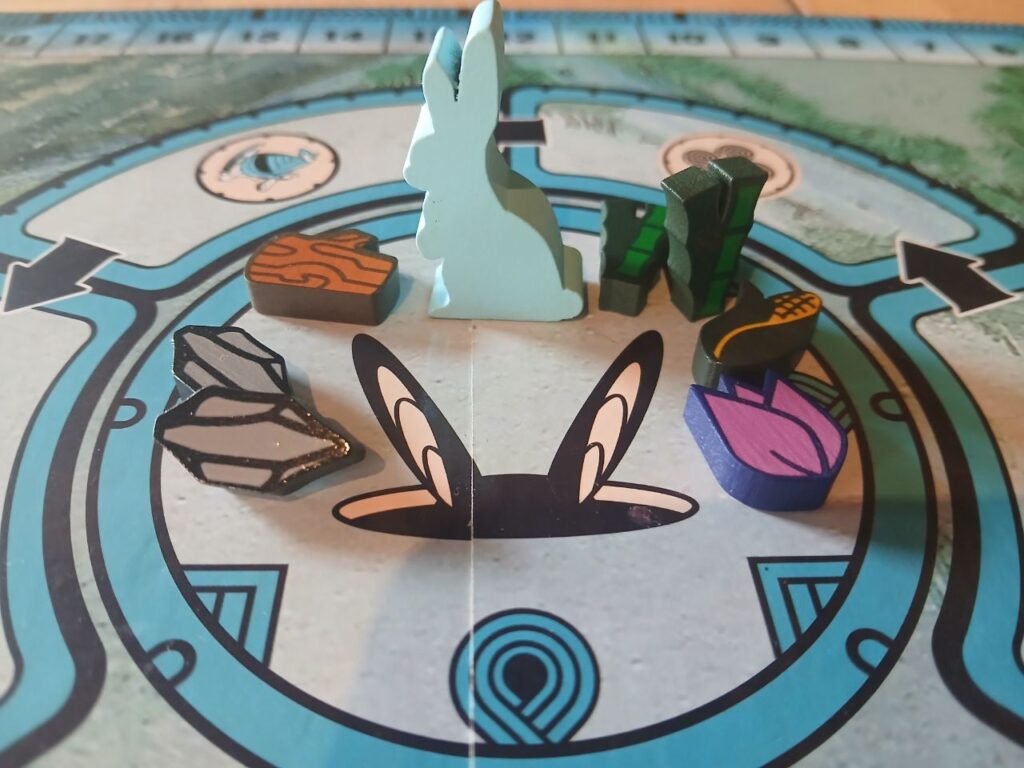
This game sets up the scene for all kinds of ludical drama, expanding the range of possible experiences in the board game world. I remember feeling, at each and every decision moment, that I was free to choose, as an independent, yet interdependent part of the game village, when to cooperate and when to focus on my own decisions. Ultimately the two are intertwined in the same fate but within the confines of our collective collaboration and survival, there is a lot of space for me to be me, and even to be a little cheeky with where I placed the Winter Rabbit’s village tokens. The relationships that I had with the other players were like the relationships that one can have with fellow tribe members (where appropriate), they are free, they can be full of trust, maybe they can hold some rivalry and conflict, but the bonds are ultimately strong. This creates a gameplay experience quite unique. One of the closest games that I could point to in feel would be Molly House, which appropriately enough also comes from a marginalised community, though its own dynamic, shifting semi-coop play has a more dangerous, tragic tone.

This freewheeling rhythm of the game can often take a similar form in the matches that we played. The game is tight enough that the village does have to cooperate significantly, and sometimes in quite a coordinated way, to pack away food, clothes, and tools for winter, and then at the end there is a moment when those conditions are achieved, and suddenly the village realises that it’s just a joyful competition at that point. Those that were competing harder through the game, pick up their pace, while those that had dedicated themselves more fully to a cooperative style of gaming, suddenly found themselves in a new game. That moment was a bit anti-climactic for some; they didn’t feel the same drive to carry on and finish, and so the game has the potential to leave some players feeling like it’s not a 100% tight experience.
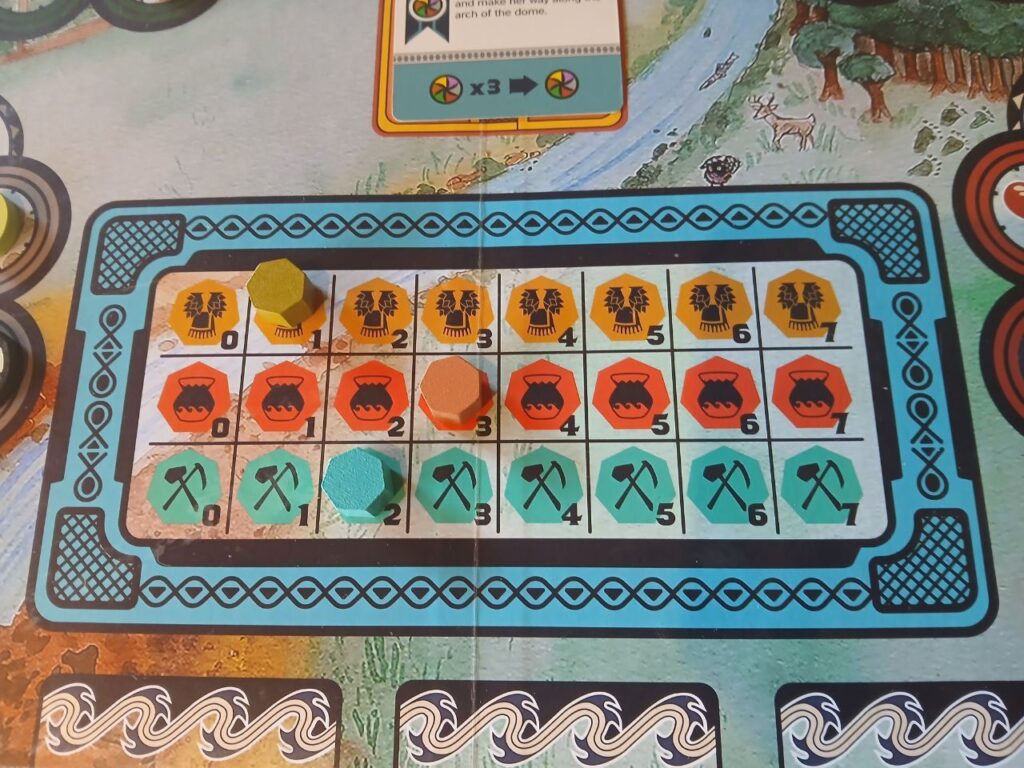
Winter Rabbit is a unique experience, and if it has come out ten or fifteen years ago, it might even have attracted the attention it deserves, but I suspect a number of factors will hold it back. One is the flow: early stress builds into late game tension, which, once the thresholds are crossed, can melt the tension for many. Also its length for depth ratio might not work for everyone. It’s a bit long for the very simple kinds of turns one plays. But it’s an important game, and it admirably achieves what it sets out to do.
Extra post review thoughts:
I would love to live in a world where Winter Rabbit acts as a popular catalyst, the way Settlers of Catan (which is similarly a bit long for its simplicity) did for European gaming, becoming both an entry way into the hobby and the inspiration for a whole world of board gaming inspired by our (non European) cultural values and understanding of the world. Realistically though, the world of board game consumers is as shaped by western colonial culture as is the pool of designers. There probably isn’t as much of a market for 4C games as there are for 4X games. And I chose my words carefully there: Consumers. Market. The very structure in which games are created and shared in our modern world is of course done through the filter of colonial capitalism. Nonetheless, it would be wonderful to see Winter Rabbit as a harbinger of a new age of indigiplay games.
I think that an interesting theoretical strand to bring into tabletop gaming critique is Reader-Response Theory, from literary theory, in particular Social Reader Response theory. In the eighties Stanley Fish developed the concept of how interpretive communities shape how each reader will come to a text (or in our case, board game), and what meaning or experience they will take away from it. The cultures that we are raised in, the subcultures that we choose, the colonialism that has infected our colonised cultures, the culture that we intentionally decolonise, all of these things affect enormously how we come out of a game, what we think of it, and what types of experiences we have in it. Europeans playing indigiplay games will have very different experiences to indigenous people playing the same games, or perhaps playing a Euro, or Ameritrash game. How we understand the individual player, the deeper meaning of our relationships with each other, even our understanding of community, or understanding of what we’re doing together playing a game will all be enormously affected by these cultural factors. How we feel the semi-coop play of Winter Rabbit will depend on the interpretive communities that we inhabit. To give a little example, I think that if one plays Winter Rabbit, more from within the interpretative community in which it was made, the question of flow might not be so problematic. The problem is essentially, that most of our players treated the game almost entirely as a cooperative, but what Winter Rabbit asks of us is to find within ourselves a different kind of competitiveness to that more destructive competitiveness that European gaming has taught us. Those players that took on this other kind of competitiveness, a sort of together-competitiveness, were, a) interestingly enough from colonized cultures and b) didn’t feel so jarred by a change in tension. There’s a lot to unpack here, but this review and analysis is already long enough so, as always, we’ll have to keep teasing out these issues in other reviews, blog posts, interviews, etc.