I’m gonna talk about decolonialism, an under-understood topic. Genuine curiosity and willingness to learn is welcome, but decolonialism itself is not up for debate on this blog. Decolonialism is a minoritarian approach and this blog is a safe space for it.
Decolonialism comes from an understanding of colonialism as a genocidal force based on white/european supremacy that infects the minds of colonised peoples, such that we (people from colonised cultures) internalise our own inferiority and so we have to go through a process of undoing that colonisation that infected us. It’s not the same as anti-colonialism, which is a general political posture that everyone can participate in, even people of european descent. In other words, all of those of us who agree that colonialism was/is a violent catastrophe can come together in anti-colonialism, and those of us who have had our cultures denegrated as inferior, and have suffered the genocidal effects of colonialism, can undergo a process of decolonizing our minds, restoring our dignity, touching back in with our roots and walking into the future recognising where we are, imagining where we could have been, and blending those realities into constructive, imaginative post-colonial futures.
So let’s talk about games! My approach in this post is playful and irreverent, so read it as such!
Today we’re looking at games set in pre-colonized Mesoamerica, a whole ecology of peoples to whom many of us look back to as an ancestral cultural heritage.
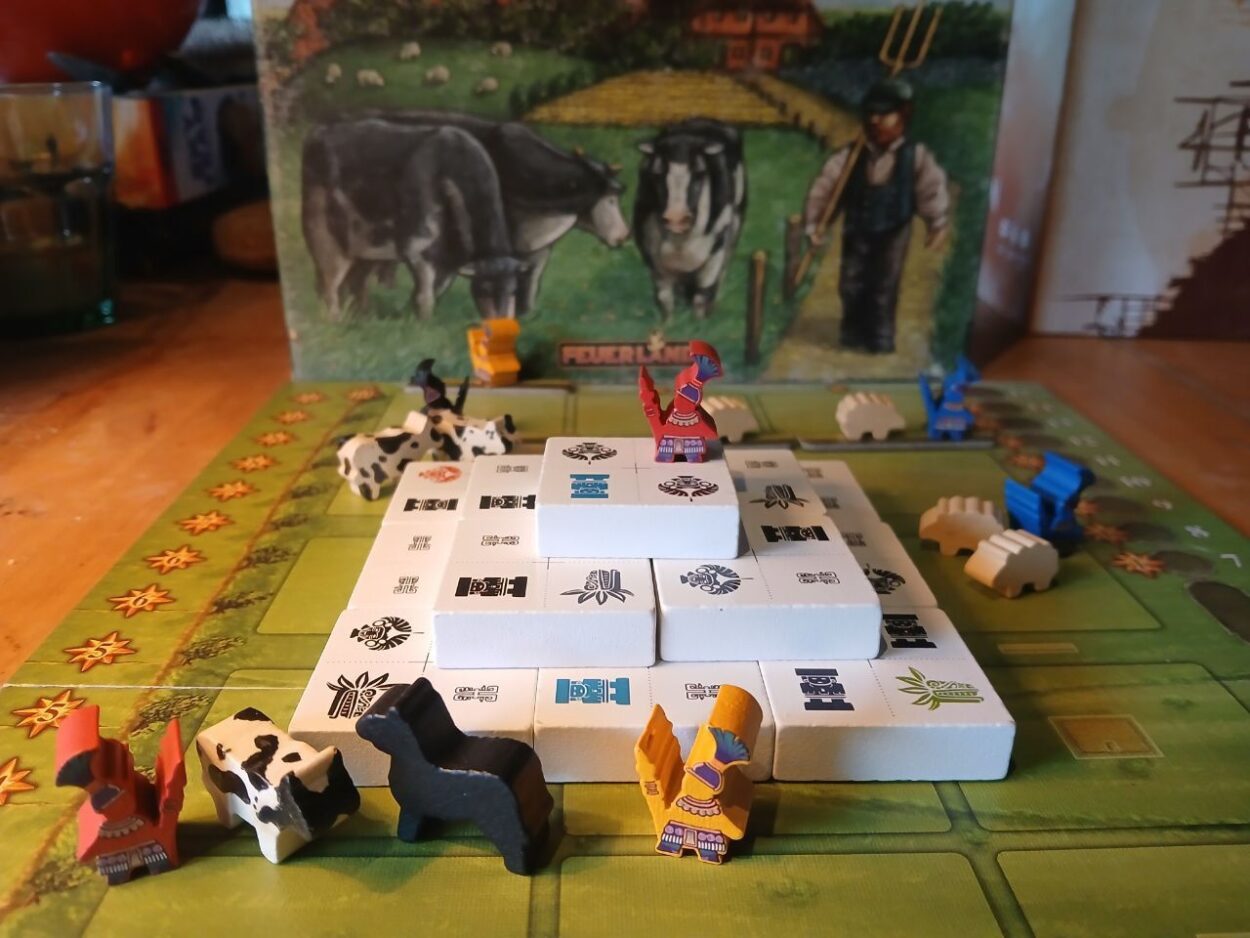
When a designer brings us a game that is rooted into the places that are important to them, it’s a very special experience. I think of Lacerda’s Lisboa, or, perhaps one of the most loving intimate examples is Uwe Rosenberg’s Fields of Arle.
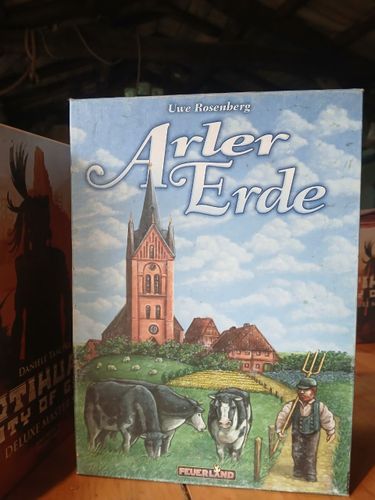
Of course, the ideal decolonized game experience for a mesoamerican themed game would be something designed by someone from those places who is trying to make games in a decolonised way. That’s just not where we’re at though.Every single game that I will highlight was designed by a European.
We can walk through a pile of games, moving away from that ideal, through the Euros and War games set in mesoamerica, that are at least historically accurate in art, and culture, through the ones whose historical accuracy is a bit fuzzy (Mexica), towards, at the far end of the spectrum, those that represent in some way colonialism itself, like Tikal, where players represent archeological teams racing through sites of ancestral importance, looting our treasures. Perhaps we can even manage to enjoy a game like Tikal, perhaps not, but we are very far away from having a special experience with the maker of the game (Fields of Arle), and we are sort of playing against the game in a way, in spite of the game, and how it came to be.
Naturally, as a part of the many consequences of colonialism— capital, social capital and design power is unevenly distributed and generally lies more in the hands of European and Euro-descdendent peoples. So European culture creates the lenses through which other cultures are seen and understood. To speak in quite rough generalizations European cultures tend to be more individualistic; the values of neo-liberal capitalism have intensely formed viewpoints on individuals, society, ethics, and just about everything; themes and settings that are chosen are often around power, empire building, “exploring”; “development” or constructing something from a “less ordered” state to a “more ordered state”. Sound familiar when it comes to gaming? It’s no coincidence that these cultural ways of understanding the world have been translated into what we often understand as “eurogames”. I’m making these points quite quickly, perhaps we can do a deeper analysis at some point about how European worldviews have shaped how we imagine what modern games can be.
But it struck me the other day, at the moment we feel like if it’s a great victory just for indigenous people/people from colonised cultures to design and publish our own games that represent ourselves, but what if we made games set in Europe, but seen through the lense of our own reclaimed different cultural values? What would that look like?

If we look at two indigenous designed games, Winter Rabbit
and Wolves, in both of them we see a fascinating reworking of the idea of what competition means, that within a group of people that are in relationship with each other, competition to win takes place, but not at the ultimate expense of the others in the group. If I win, that doesn’t mean you lose, because we have competed in a way that doesn’t threaten our stability as a group. This is so different to European conceptions of competition. Even European semi-coops don’t, as far as I know, have this element of ultimate underlying cooperation, but rather they emphasise the ultimate underlying individuality in the group that is trying to cooperate, playing with themes of traitors, suspicion, mistrust, etc.
So what would it look like to read European settings through indigenous game design eyes? What elements of European history would we focus on that may be blindspots to Europeans? Or what hilarious misinterpretations would we make?
Let’s get back to Mesoamerica. It’s a relatively popular setting for eurogames. One of the most popular (just fell out of the BGG top 100) is Teotihuacan
. It’s set in a city of incredible ancestral importance for Mesoamerica, and is designed by an Italian who fell into controversy some years for some racist comments that he was slow to apologise for. I haven’t kept up with what happened with that. I don’t really care. This isn’t about him. If you want this game, maybe buy it second hand! Teotihuacan is a pretty good variant on the progress and city building euro style game with a giant rondel, aging dice, progress pyramids to climb. A number of things leapt out at me when I started playing this game.
In the expansion Expansion Period there is an “empire board”, in which you can send out warriors to *checks notes* settle neighboring areas. It’s literally settler colonialism through war. This supposedly represents a moment in time in which Teotihuacan expanded its influence and created a sort of empire.

The problem is that there is no evidence that compels us to interpret Teotihuacan’s cultural influence in the area around it as imperial. In short, European historians (and game designers), implicitly see the world in terms of hierarchies, power, conquest, settler colonialism, and empire, and that’s why we get so many games churning out these tired tropes.
Teotihuacan’s influence as a spiritual and cultural centre grew significantly, and that influence can be seen in the cultures around it, but many of the latest theories concerning the city’s own culture at that time is that it was moving away from centralised hierarchical power that an empire would represent, and turning into a truly fascinating civic experiment, putting more and more resources into making life comfortable for a much broader class of people. The existence of these elaborate residences is represented in the game by the construction of houses for the “noble class”.
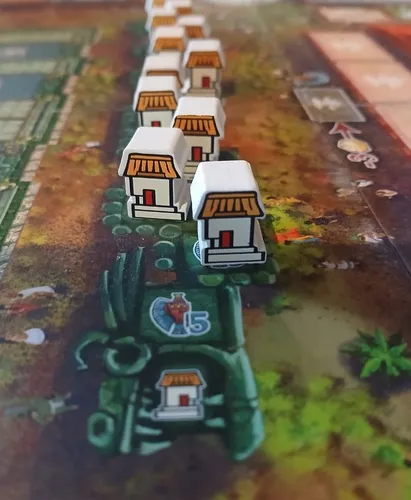
But the “Expansion” period that brought in the Empire board for some good old fashioned settler colonialism was one in which a profound shift was going on in the real history of Teotihuacan. Unlike the game, which invented the construction of a new fictitious pyramid to centre its play around (Euros love the construction of new things rather things, where as indigenous cultures often put focus on taking care of the things we already have (check out my soon to be published review of Winter Rabbit for more on this)), The Teotihuacan society had stopped building grand pyramids, and for quite a long period of time, just as its cultural influence (not empire) was expanding, it put an enormous amount of resources into making elaborate dwellings. Quality of life for ordinary folks seemed to be the priority of that massively influential city. This represents a fascinating political shift, and would have made for a great game (perhaps one we can make someday as an indigiplay games (indigiplay rivals eurogames and ameritrash as a new kind of gaming experience.) But Teotihuacan the game is a euro, and so all of this potential politics is flattened out for resource management, point salads and endless expansion.
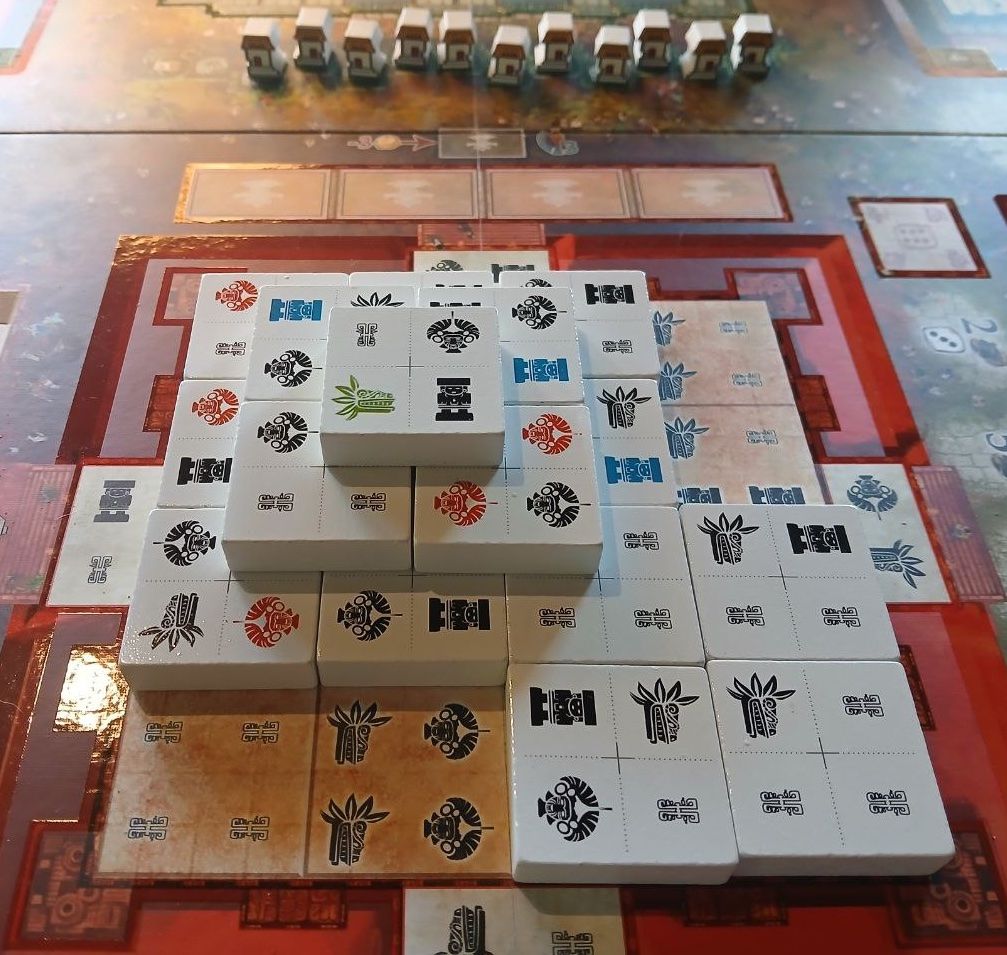
The pyramid construction towering over the housing complexes of the Avenue of the Dead.
This isn’t a historical essay, so we won’t be going into details, but the crucial point is that the bias of a European perspective imagines empire and conquest, and so we play games about our ancestors through European eyes.
Here’s another relatively trivial point for fun. Teotihuacan
plays out on a massive rondel that represents the city, and you move on that rondel in a clockwise direction. Why? Why is it clockwise? If someone proves me wrong I’ll eat my words, but I can only imagine it’s clockwise because that is the dominant European conventional direction for gameplay. The Cherokee designed game Winter Rabbit has already marked out an alternative to that, and all gameplay is counter, clockwise, to represent the direction of dance in traditional ceremonies. If you feel like winning a petty little victory over European dominance in your Mesoamerican games, I suggest going counterclockwise around the rondel in Teotihuacan. Will it make colonialism go away? Nope. But it might make you laugh and feel a bit rebellious. And decolonialism is all about feeling a little bit rebellious, and then a bit more rebellious, and then outright defiant until we cast off our inferiority and really began challenging the hegemony of Eurocentric culture outright. Maybe we’ll even make some of our own games once we’re fired up enough. Oh and while you’re at it, rename the Empire board, the Board of cultural exchange … or something. I don’t know. With the warrior pieces and everything you have to send out, it requires a little creativity to decolonize your play of that particular “Empire” module
Tiny acts of gaming defiance aside, here’s an oddity about BGG and Teotihuacan. Teotihuacan is classified in the “Ancient” historical category.
The other historical categories are: Prehistoric, Medieval, Renaissance, Pike and Shot, Age of Reason, Napoleonic, Post-Napoleonic, World War I, World War II, Korean War, Vietnam War, Modern Warfare.
Notice anything about these categories? They mirror a Eurocentric (and then U.S. centric) view of history and the world. 100%.
How does Chinese history fit into these categories? Indian? African? They don’t. Mesoamerican? Nope. Apparently it’s all just “ancient” but even that is eurocentric. Here’s the description.
Ancient games often have themes or storylines set in the Old World, between 3000 BC (the beginning of the Egyptian dynasties) and AD 476 (the fall of the Western Roman Empire). Some of the themes and imagery found in the most popular Ancient games concerns ancient Egyptian, Greek, and Roman civilizations.
I get it. BGG is English speaking, it’s formed and moulded by an anglo world view, which just happens to be eurocentric, imperialistic and colonial in its assumptions.
All of our non European culture is just jammed into a European framework. Old World/New World is outdated colonial terminology. Who do we take this up with at BGG? Can we make new categories?
Decolonizing our Mesoamerican gaming would mean taking games about our peoples (no matter who designed them) out of these completely ill-fitting European categories, and starting to figure out how we want to talk about ourselves. REALLY decolonising our games would mean that we start making games from our own communities, from our own decolonised perspectives. In the modern board game hobby this is actually beginning with Winter Rabbit, Wolves, Nawalli, and in the RPG world, Coyote and Crow. I’ll have a review of Winter Rabbit coming up soon. Spoiler: decolonising our play broadens out the potential play space for everyone. The more cultures that throw off the sense of inferiority that colonialism steeped them in, and begin adding unique new voices to gaming, the richer our table top gaming world will be.